Ch.17 - Aqueous Ionic Equilibrium
Tro - Chemistry: A Molecular Approach 4th Edition
Tro4th EditionChemistry: A Molecular ApproachISBN: 9780134112831Non è quello che usi tu?Cambia libro di testo
Capitolo 17, Problema 53b

Determine whether or not the mixing of each pair of solutions results in a buffer. b. 50.0 mL of 0.10 M HCl; 35.0 mL of 0.150 M NaOH

Guida verificata passo dopo passo
1
Identify the components of the solutions: HCl is a strong acid and NaOH is a strong base.
Calculate the moles of HCl: \( \text{moles of HCl} = 0.10 \, M \times 0.050 \, L \).
Calculate the moles of NaOH: \( \text{moles of NaOH} = 0.150 \, M \times 0.035 \, L \).
Determine the limiting reactant by comparing the moles of HCl and NaOH.
Assess if there is an excess of either component after the reaction. A buffer forms if there is a weak acid or weak base and its conjugate present in significant amounts.

Risposta video verificata per un problema simile:

Questa soluzione video è stata consigliata dai nostri tutor come utile per risolvere questo problema.
Durata del video:
6m

Concetti chiave

Ecco i concetti essenziali che devi comprendere per rispondere correttamente alla domanda.

Buffer Solutions

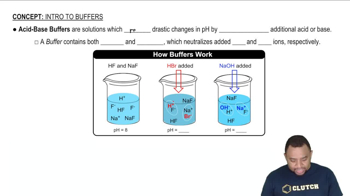
A buffer solution is a system that resists changes in pH upon the addition of small amounts of acid or base. It typically consists of a weak acid and its conjugate base or a weak base and its conjugate acid. Buffers are crucial in maintaining stable pH levels in various chemical and biological processes.
Video consigliato:
Percorso guidato
03:02
Buffer Solutions

Strong Acids and Bases

Strong acids, like HCl, completely dissociate in water, releasing all their protons (H+), while strong bases, like NaOH, completely dissociate to produce hydroxide ions (OH-). The complete dissociation of these substances means they do not form a buffer solution when mixed, as they do not provide the weak acid/base pair necessary for buffering.
Video consigliato:
Percorso guidato
01:09
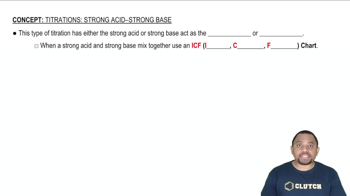
Strong Acid-Strong Base Titration

Neutralization Reaction

A neutralization reaction occurs when an acid reacts with a base to produce water and a salt. In the given scenario, mixing HCl and NaOH will lead to a neutralization reaction, resulting in the formation of water and sodium chloride (NaCl). This reaction will not create a buffer, as it consumes both the acid and base completely.
Video consigliato:
Percorso guidato
05:56
Lewis Dot Structures: Neutral Compounds