Ch.18 - Free Energy and Thermodynamics
Tro - Chemistry: A Molecular Approach 4th Edition
Tro4th EditionChemistry: A Molecular ApproachISBN: 9780134112831Non è quello che usi tu?Cambia libro di testo
Capitolo 18, Problema 41

Given the values of ΔH° rxn, ΔS° rxn, and T, determine ΔSuniv and predict whether each reaction is spontaneous. Assume that all reactants and products are in their standard states. b. ΔH° rxn = -115 kJ; ΔS° rxn = +263 J/K; T = 298 K; d. ΔH° rxn = -115 kJ; ΔS° rxn = -263 J/K; T = 615 K.

Guida verificata passo dopo passo
1
Convert \( \Delta H^\circ_{rxn} \) from kJ to J by multiplying by 1000, since \( \Delta S^\circ_{rxn} \) is given in J/K.
Calculate \( \Delta G^\circ_{rxn} \) using the formula \( \Delta G^\circ_{rxn} = \Delta H^\circ_{rxn} - T \Delta S^\circ_{rxn} \).
Determine \( \Delta S_{univ} \) using the relationship \( \Delta S_{univ} = -\frac{\Delta G^\circ_{rxn}}{T} \).
Evaluate the sign of \( \Delta S_{univ} \): if positive, the reaction is spontaneous; if negative, it is non-spontaneous.
Repeat the above steps for each set of given values to determine spontaneity for each reaction.

Concetti chiave

Ecco i concetti essenziali che devi comprendere per rispondere correttamente alla domanda.

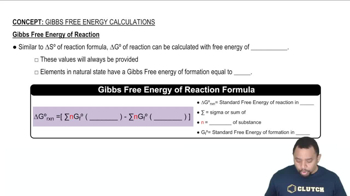
Gibbs Free Energy

Gibbs Free Energy (G) is a thermodynamic potential that helps predict the spontaneity of a reaction at constant temperature and pressure. It is defined as G = ΔH - TΔS, where ΔH is the change in enthalpy, T is the temperature in Kelvin, and ΔS is the change in entropy. A reaction is spontaneous if ΔG is negative, indicating that the process can occur without external energy input.
Video consigliato:
Percorso guidato
01:51
Gibbs Free Energy of Reactions

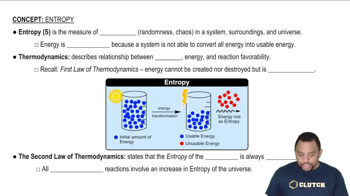
Entropy (ΔS)

Entropy (ΔS) is a measure of the disorder or randomness in a system. A positive ΔS indicates an increase in disorder, which generally favors spontaneity, while a negative ΔS suggests a decrease in disorder. In the context of reactions, the change in entropy can significantly influence the overall spontaneity when combined with temperature in the Gibbs Free Energy equation.
Video consigliato:
Percorso guidato
02:46
Entropy in Thermodynamics

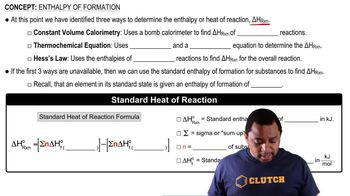
Enthalpy (ΔH)

Enthalpy (ΔH) is the total heat content of a system and reflects the energy change during a chemical reaction. A negative ΔH indicates an exothermic reaction, releasing heat and often favoring spontaneity, while a positive ΔH indicates an endothermic reaction, absorbing heat. The interplay between ΔH and ΔS at a given temperature is crucial for determining the spontaneity of a reaction.
Video consigliato:
Percorso guidato
02:34
Enthalpy of Formation