Ch.18 - Free Energy and Thermodynamics
Tro - Chemistry: A Molecular Approach 4th Edition
Tro4th EditionChemistry: A Molecular ApproachISBN: 9780134112831Non è quello che usi tu?Cambia libro di testo
Capitolo 18, Problema 37c

Without doing any calculations, determine the signs of ΔSsys and ΔSsurr for each chemical reaction. In addition, predict under what temperatures (all temperatures, low temperatures, or high temperatures), if any, the reaction is spontaneous. c. 2 N2(g) + O2(g) → 2 N2O(g) ΔH°rxn = +163.2 kJ

Guida verificata passo dopo passo
1
Consider the reaction: 2 N_2(g) + O_2(g) \(\rightarrow\) 2 N_2O(g). Note that the reaction involves gases, and the number of moles of gas decreases from 3 moles (2 N_2 + 1 O_2) to 2 moles (2 N_2O).
Since the number of moles of gas decreases, the system becomes more ordered, leading to a decrease in entropy of the system (ΔS_{sys} < 0).
The reaction is endothermic as indicated by the positive ΔH°_{rxn} = +163.2 \(\text{ kJ}\), meaning it absorbs heat from the surroundings, which decreases the entropy of the surroundings (ΔS_{surr} < 0).
For a reaction to be spontaneous, the total entropy change (ΔS_{univ} = ΔS_{sys} + ΔS_{surr}) must be positive. In this case, both ΔS_{sys} and ΔS_{surr} are negative, suggesting the reaction is not spontaneous at any temperature.
However, if the reaction were to become spontaneous, it would require conditions where the entropy change of the surroundings could become positive enough to offset the negative ΔS_{sys}, which is unlikely given the endothermic nature of the reaction.

Risposta video verificata per un problema simile:

Questa soluzione video è stata consigliata dai nostri tutor come utile per risolvere questo problema.
Durata del video:
5m

Concetti chiave

Ecco i concetti essenziali che devi comprendere per rispondere correttamente alla domanda.

Entropy (ΔS)

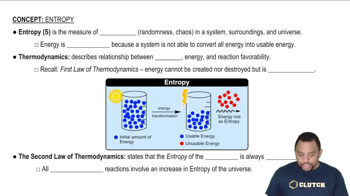
Entropy, denoted as ΔS, is a measure of the disorder or randomness in a system. In chemical reactions, an increase in the number of gas molecules typically leads to a positive change in entropy, while a decrease results in a negative change. Understanding how the arrangement of molecules changes during a reaction is crucial for predicting the sign of ΔS for both the system and surroundings.
Video consigliato:
Percorso guidato
02:46
Entropy in Thermodynamics

Enthalpy (ΔH) and Spontaneity

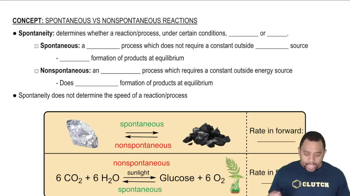
Enthalpy change (ΔH) reflects the heat absorbed or released during a reaction. A positive ΔH indicates an endothermic reaction, which can affect spontaneity. The Gibbs free energy equation (ΔG = ΔH - TΔS) helps determine if a reaction is spontaneous; if ΔG is negative, the reaction is spontaneous. The interplay between ΔH and ΔS at different temperatures is key to predicting spontaneity.
Video consigliato:
Percorso guidato
04:20
Spontaneity of Processes

Gibbs Free Energy (ΔG)

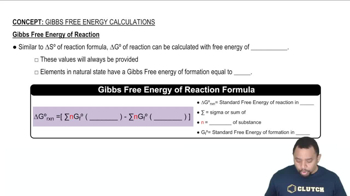
Gibbs free energy (ΔG) combines enthalpy and entropy to predict the spontaneity of a reaction. A reaction is spontaneous when ΔG is negative, which can occur under certain temperature conditions depending on the signs of ΔH and ΔS. For the given reaction, analyzing the signs of ΔS and ΔH will help determine the temperature range for spontaneity, highlighting the importance of temperature in thermodynamic processes.
Video consigliato:
Percorso guidato
01:51
Gibbs Free Energy of Reactions