Ch.20 - Radioactivity and Nuclear Chemistry
Tro - Chemistry: A Molecular Approach 4th Edition
Tro4th EditionChemistry: A Molecular ApproachISBN: 9780134112831Non è quello che usi tu?Cambia libro di testo
Capitolo 20, Problema 68

Calculate the mass defect and nuclear binding energy per nucleon of each nuclide. a. Li-7 (atomic mass = 7.016003 amu)

Guida verificata passo dopo passo
1
Li-7 consists of 3 protons and 4 neutrons. The atomic mass of a proton is approximately 1.007276 amu, and the atomic mass of a neutron is approximately 1.008665 amu.
Multiply the number of protons by the mass of a proton and the number of neutrons by the mass of a neutron, then sum these values to find the total mass of the nucleons.
Subtract the actual atomic mass of Li-7 (7.016003 amu) from the total mass of the nucleons calculated in Step 2. This difference is the mass defect.
Use Einstein's equation, E=mc^2, where c is the speed of light (approximately 3.00 x 10^8 m/s). Convert the mass defect from amu to kilograms (1 amu = 1.660539 x 10^-27 kg) and then calculate the energy in joules.
Divide the total nuclear binding energy (from Step 4) by the number of nucleons in Li-7 (which is 7) to find the binding energy per nucleon.>

Risposta video verificata per un problema simile:

Questa soluzione video è stata consigliata dai nostri tutor come utile per risolvere questo problema.
Durata del video:
8m

Concetti chiave

Ecco i concetti essenziali che devi comprendere per rispondere correttamente alla domanda.

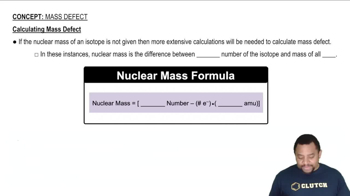
Mass Defect

The mass defect is the difference between the mass of an atomic nucleus and the sum of the individual masses of its protons and neutrons. This discrepancy arises because some mass is converted into energy when nucleons bind together, according to Einstein's equation E=mc². The mass defect is crucial for understanding nuclear stability and energy release in nuclear reactions.
Video consigliato:
Percorso guidato
00:55
Calculating Mass Defect

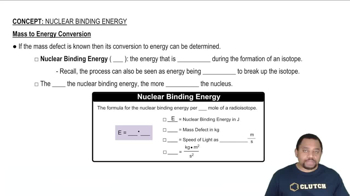
Nuclear Binding Energy

Nuclear binding energy is the energy required to disassemble a nucleus into its constituent protons and neutrons. It is directly related to the mass defect; the greater the mass defect, the higher the binding energy. This energy is a measure of the stability of a nucleus: a higher binding energy indicates a more stable nucleus, while a lower binding energy suggests it is more likely to undergo radioactive decay.
Video consigliato:
Percorso guidato
02:06
Nuclear Binding Energy

Binding Energy per Nucleon

Binding energy per nucleon is the average energy that binds each nucleon (proton or neutron) in a nucleus. It is calculated by dividing the total binding energy of the nucleus by the number of nucleons. This value is useful for comparing the stability of different nuclei; generally, nuclei with higher binding energy per nucleon are more stable and less likely to undergo fission or fusion.
Video consigliato:
Percorso guidato
02:06
Nuclear Binding Energy