Ch.20 - Radioactivity and Nuclear Chemistry
Tro - Chemistry: A Molecular Approach 4th Edition
Tro4th EditionChemistry: A Molecular ApproachISBN: 9780134112831Non è quello che usi tu?Cambia libro di testo
Capitolo 20, Problema 65

If 1.0 g of matter is converted to energy, how much energy is formed?

Guida verificata passo dopo passo
1
insert step 1> Determine the formula to use for converting mass to energy. The relevant equation is Einstein's mass-energy equivalence formula: \(E = mc^2\), where \(E\) is energy, \(m\) is mass, and \(c\) is the speed of light in a vacuum.
insert step 2> Identify the given values in the problem. Here, the mass \(m\) is 1.0 g. Note that the speed of light \(c\) is a constant, approximately \(3.00 \times 10^8\) m/s.
insert step 3> Convert the mass from grams to kilograms, since the standard unit of mass in physics is kilograms. Remember that 1 kg = 1000 g, so 1.0 g = 0.001 kg.
insert step 4> Substitute the values into the equation \(E = mc^2\). Use \(m = 0.001\) kg and \(c = 3.00 \times 10^8\) m/s.
insert step 5> Calculate the energy \(E\) by performing the multiplication. This will give you the energy in joules (J), which is the standard unit of energy in the International System of Units (SI).

Risposta video verificata per un problema simile:

Questa soluzione video è stata consigliata dai nostri tutor come utile per risolvere questo problema.
Durata del video:
1m

Concetti chiave

Ecco i concetti essenziali che devi comprendere per rispondere correttamente alla domanda.

Einstein's Mass-Energy Equivalence

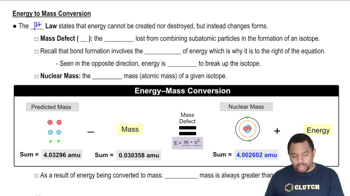
Einstein's mass-energy equivalence principle, expressed by the equation E=mc², states that mass can be converted into energy. In this equation, E represents energy, m is mass, and c is the speed of light in a vacuum (approximately 3.00 x 10^8 m/s). This principle underlies nuclear reactions and explains how a small amount of mass can yield a large amount of energy.
Video consigliato:
Percorso guidato
04:12
Energy to Mass Conversion

Unit Conversion

In chemistry and physics, unit conversion is essential for accurately calculating quantities. When converting mass to energy using E=mc², it is crucial to ensure that the mass is in kilograms (kg) since the speed of light is in meters per second (m/s). For example, 1.0 g of matter must be converted to kilograms (1.0 g = 0.001 kg) before applying the equation.
Video consigliato:
Percorso guidato
01:56
Conversion Factors

Energy Units

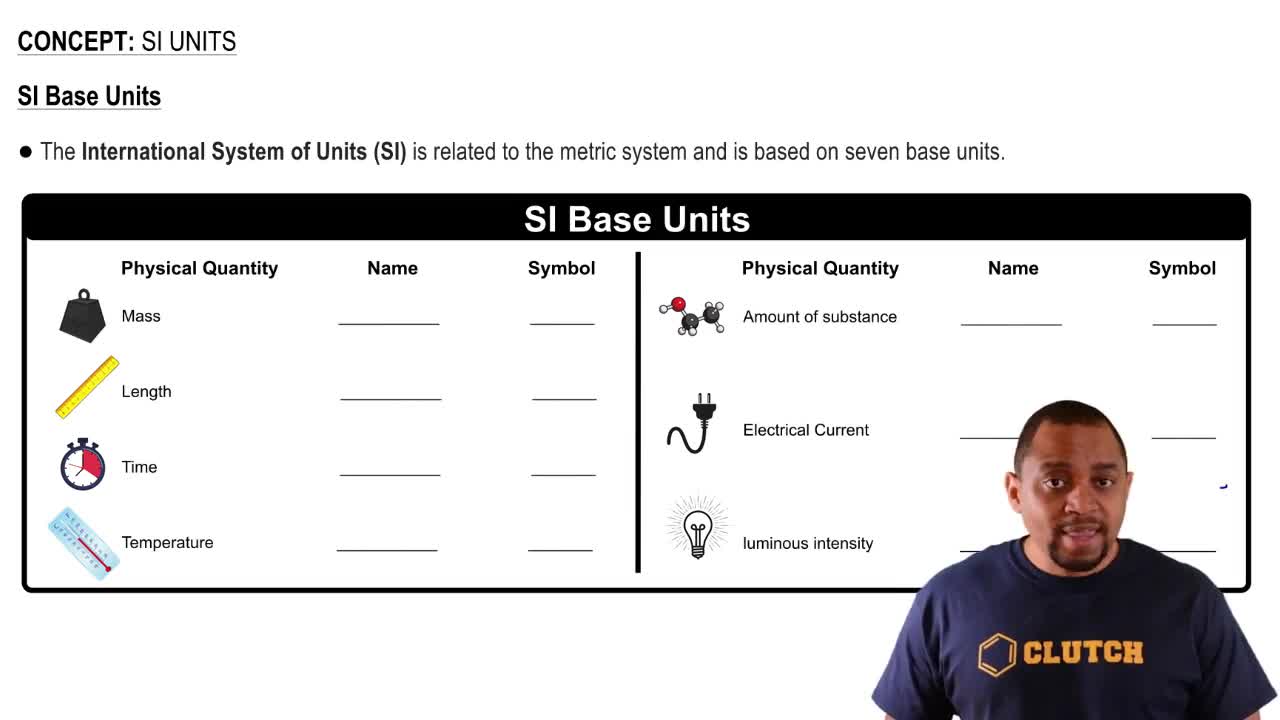
Energy is commonly measured in joules (J) in the International System of Units (SI). Understanding how to express energy in joules is important when calculating the energy produced from mass conversion. For instance, using E=mc² with the correct mass in kilograms will yield the energy in joules, allowing for a clear understanding of the energy produced from the conversion of matter.
Video consigliato: