A balloon contains 0.158 mol of gas and has a volume of 2.46 L. If an additional 0.113 mol of gas is added to the balloon (at the same temperature and pressure), what is its final volume?
Ch.5 - Gases
Tro4th EditionChemistry: A Molecular ApproachISBN: 9780134112831Non è quello che usi tu?Cambia libro di testo
Capitolo 5, Problema 36
A cylinder with a moveable piston contains 0.553 mol of gas and has a volume of 253 mL. What is its volume if an additional 0.365 mol of gas is added to the cylinder? (Assume constant temperature and pressure.)
Guida verificata passo dopo passo1
Identify the initial conditions and the final conditions. Initially, there are 0.553 mol of gas in a volume of 253 mL.
Determine the total amount of gas after adding 0.365 mol to the initial amount. This is done by summing up the initial moles and the additional moles.
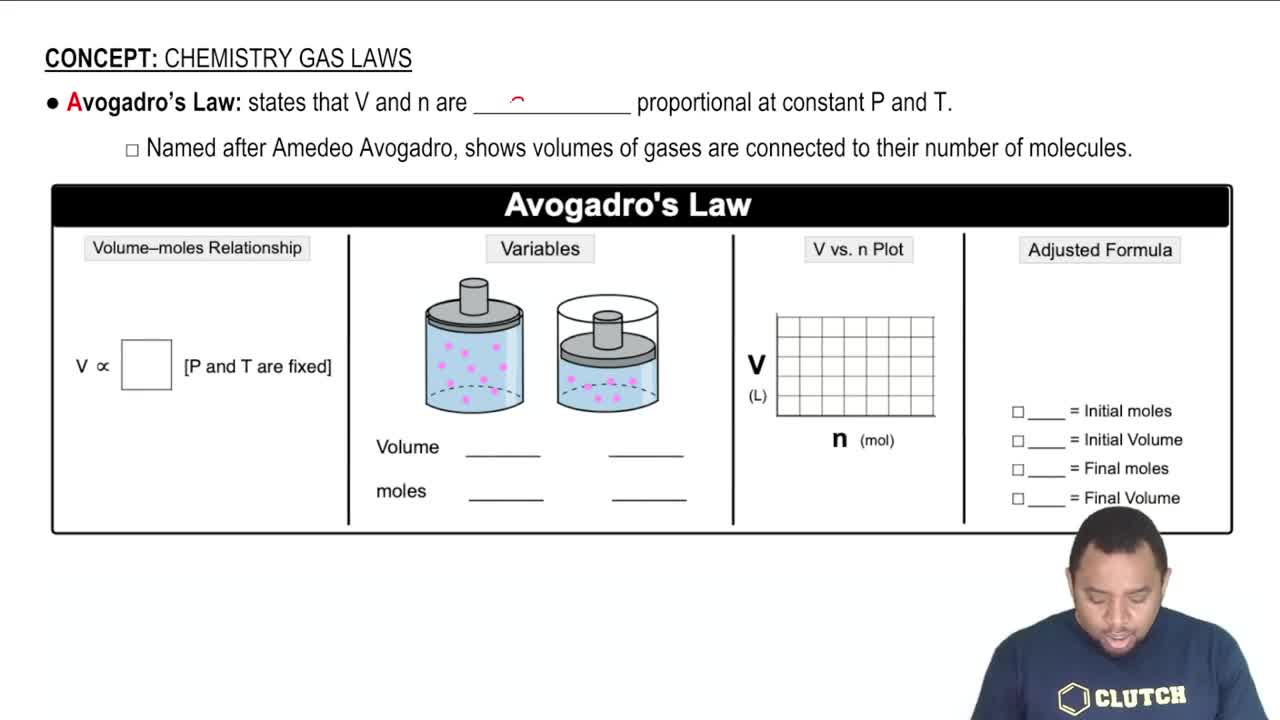
Use the direct proportionality of moles and volume under constant temperature and pressure (Avogadro's Law), which states that the volume of a gas is directly proportional to the number of moles of the gas when temperature and pressure are held constant.
Set up a proportion based on Avogadro's Law: \( \frac{V_1}{n_1} = \frac{V_2}{n_2} \), where \(V_1\) and \(n_1\) are the initial volume and number of moles, and \(V_2\) and \(n_2\) are the final volume and total number of moles.
Solve the proportion for \(V_2\) to find the new volume of the gas in the cylinder.

Risposta video verificata per un problema simile:
Questa soluzione video è stata consigliata dai nostri tutor come utile per risolvere questo problema.
Durata del video:
2mConcetti chiave
Ecco i concetti essenziali che devi comprendere per rispondere correttamente alla domanda.
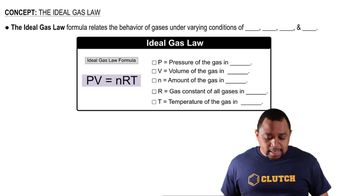
Ideal Gas Law
The Ideal Gas Law relates the pressure, volume, temperature, and number of moles of a gas through the equation PV = nRT. In this scenario, since temperature and pressure are constant, the relationship between the number of moles and volume can be simplified, allowing us to determine how the volume changes with the addition of gas.
Video consigliato:
Percorso guidato
Ideal Gas Law Formula
Avogadro's Law
Avogadro's Law states that at constant temperature and pressure, the volume of a gas is directly proportional to the number of moles of gas present. This principle is crucial for solving the problem, as it allows us to predict how the volume will increase when more moles of gas are added to the cylinder.
Video consigliato:
Percorso guidato
Avogadro's Law
Conservation of Volume
In a closed system with a moveable piston, the total volume can change as gas is added or removed. The conservation of volume principle indicates that the volume occupied by the gas will adjust according to the number of moles present, provided that temperature and pressure remain constant, which is essential for calculating the new volume after adding gas.
Video consigliato:
Percorso guidato
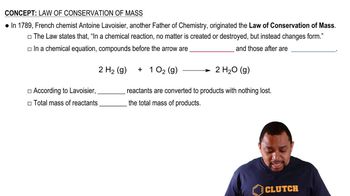
Law of Conservation of Mass
Pratica correlata
Domanda del libro di testo
3618
views
1
rank
Domanda del libro di testo
What volume is occupied by 12.5 g of argon gas at a pressure of 1.05 atm and a temperature of 322 K? Would the volume be different if the sample were 12.5 g of helium (under identical conditions)?
1838
views
1
comments
Domanda del libro di testo
A syringe containing 1.55 mL of oxygen gas is cooled from 95.3 °C to 0.0 °C. What is the final volume of oxygen gas?
2837
views
1
rank
Domanda del libro di testo
What volume is occupied by 0.118 mol of helium gas at a pressure of 0.97 atm and a temperature of 305 K?
817
views
Domanda del libro di testo
A 48.3-mL sample of gas in a cylinder is warmed from 22 °C to 87 °C. What is its volume at the final temperature?
2726
views
1
rank
1
comments
Domanda del libro di testo
What volume is occupied by 0.118 mol of helium gas at a pressure of 0.97 atm and a temperature of 305 K? Would the volume be different if the gas was argon (under the same conditions)?
1929
views
1
rank