Ch.5 - Gases
Tro - Chemistry: A Molecular Approach 4th Edition
Tro4th EditionChemistry: A Molecular ApproachISBN: 9780134112831Non è quello che usi tu?Cambia libro di testo
Capitolo 5, Problema 34

A syringe containing 1.55 mL of oxygen gas is cooled from 95.3 °C to 0.0 °C. What is the final volume of oxygen gas?

Guida verificata passo dopo passo
1
Identify the initial and final temperatures: \( T_1 = 95.3 \, ^\circ\text{C} \) and \( T_2 = 0.0 \, ^\circ\text{C} \). Convert these temperatures to Kelvin by adding 273.15 to each.
Use Charles's Law, which states that \( \frac{V_1}{T_1} = \frac{V_2}{T_2} \), where \( V_1 \) and \( V_2 \) are the initial and final volumes, and \( T_1 \) and \( T_2 \) are the initial and final temperatures in Kelvin.
Substitute the known values into Charles's Law: \( V_1 = 1.55 \, \text{mL} \), \( T_1 = 95.3 + 273.15 \, \text{K} \), and \( T_2 = 0.0 + 273.15 \, \text{K} \).
Rearrange the equation to solve for \( V_2 \): \( V_2 = V_1 \times \frac{T_2}{T_1} \).
Calculate \( V_2 \) using the rearranged equation to find the final volume of the oxygen gas.

Risposta video verificata per un problema simile:

Questa soluzione video è stata consigliata dai nostri tutor come utile per risolvere questo problema.

Concetti chiave

Ecco i concetti essenziali che devi comprendere per rispondere correttamente alla domanda.

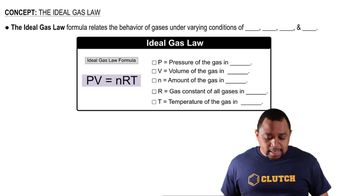
Ideal Gas Law

The Ideal Gas Law relates the pressure, volume, temperature, and number of moles of a gas through the equation PV = nRT. This law assumes that gases behave ideally, meaning they occupy no volume and have no intermolecular forces. Understanding this relationship is crucial for solving problems involving gas behavior under changing conditions.
Video consigliato:
Percorso guidato
01:15
Ideal Gas Law Formula

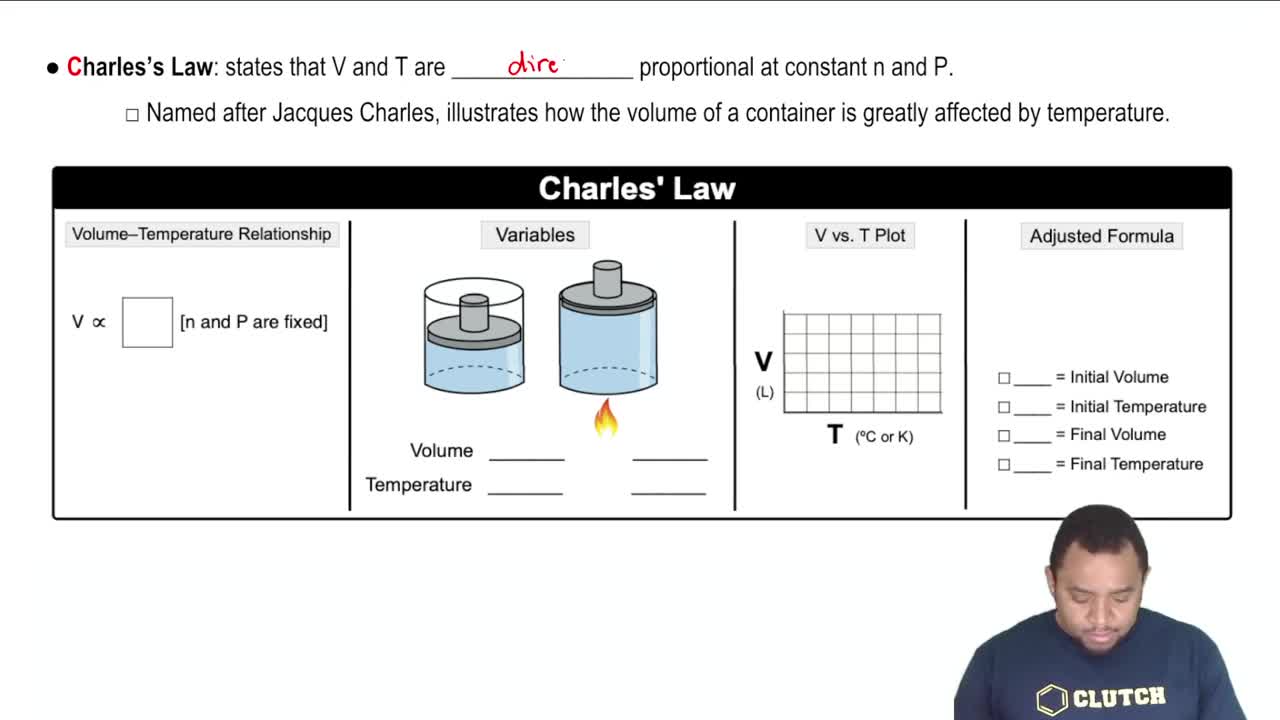
Charles's Law

Charles's Law states that the volume of a gas is directly proportional to its temperature (in Kelvin) when pressure is held constant. This means that as the temperature of a gas decreases, its volume also decreases. This principle is essential for calculating the final volume of gas when the temperature changes, as in the given question.
Video consigliato:

Temperature Conversion

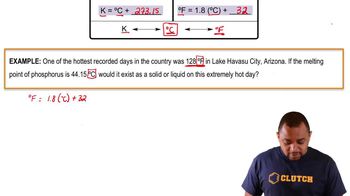
In gas law calculations, temperatures must be expressed in Kelvin rather than Celsius. The conversion from Celsius to Kelvin is done by adding 273.15 to the Celsius temperature. This conversion is necessary to ensure accurate calculations when applying gas laws, as they require absolute temperature values.
Video consigliato:
Percorso guidato
02:10
Temperature Conversion Example