Ch.1 - Matter, Measurement & Problem Solving
Tro - Chemistry: A Molecular Approach 5th Edition
Tro5th EditionChemistry: A Molecular ApproachISBN: 9780134874371Non è quello che usi tu?Cambia libro di testo
Capitolo 1, Problema 69b

Ethylene glycol (antifreeze) has a density of 1.11 g/cm3. a. What is the mass in g of 417 mL of ethylene glycol? b. What is the volume in L of 4.1 kg of ethylene glycol?

Guida verificata passo dopo passo
1
Step 1: Understand the relationship between mass, volume, and density. The formula to use is: \( \text{Density} = \frac{\text{Mass}}{\text{Volume}} \).
Step 2: For part (a), rearrange the formula to find mass: \( \text{Mass} = \text{Density} \times \text{Volume} \).
Step 3: Convert the volume from mL to cm³ for part (a), knowing that 1 mL = 1 cm³. Therefore, 417 mL = 417 cm³.
Step 4: Substitute the given values into the formula for part (a): \( \text{Mass} = 1.11 \text{ g/cm}^3 \times 417 \text{ cm}^3 \).
Step 5: For part (b), rearrange the formula to find volume: \( \text{Volume} = \frac{\text{Mass}}{\text{Density}} \). Convert the mass from kg to g, knowing that 1 kg = 1000 g, so 4.1 kg = 4100 g. Then, substitute the values into the formula: \( \text{Volume} = \frac{4100 \text{ g}}{1.11 \text{ g/cm}^3} \). Convert the result from cm³ to L, knowing that 1000 cm³ = 1 L.

Risposta video verificata per un problema simile:

Questa soluzione video è stata consigliata dai nostri tutor come utile per risolvere questo problema.

Concetti chiave

Ecco i concetti essenziali che devi comprendere per rispondere correttamente alla domanda.

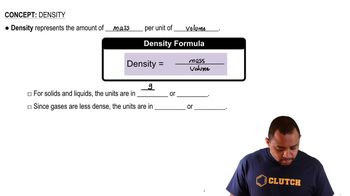
Density

Density is defined as the mass of a substance per unit volume, typically expressed in grams per cubic centimeter (g/cm³) or kilograms per liter (kg/L). It is a crucial property that helps in determining how much mass is contained in a given volume of a substance. In this question, the density of ethylene glycol is used to calculate the mass from volume and vice versa.
Video consigliato:
Percorso guidato
01:56
Density Concepts

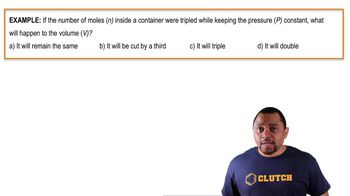
Mass-Volume Relationship

The mass-volume relationship is a fundamental concept in chemistry that describes how mass and volume are interrelated through density. The formula used is mass = density × volume. This relationship allows for the conversion between mass and volume when the density of a substance is known, which is essential for solving the parts of the question regarding ethylene glycol.
Video consigliato:
Percorso guidato
01:09
Relationship of Volume and Moles Example

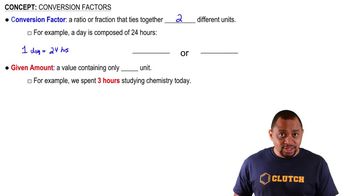
Unit Conversion

Unit conversion is the process of converting a quantity expressed in one set of units to another. In this question, it is necessary to convert between milliliters (mL) and liters (L) as well as between grams (g) and kilograms (kg). Understanding how to perform these conversions is vital for accurately answering the question and ensuring that all measurements are in compatible units.
Video consigliato:
Percorso guidato
01:56
Conversion Factors