Consider the reaction: NH4HS(s) ⇌ NH3(g) + H2S(g) At a certain temperature, Kc = 8.5⨉10-3. A reaction mixture at this temperature containing solid NH4HS has [NH3] = 0.166 M and [H2S] = 0.166 M. Will more of the solid form or will some of the existing solid decompose as equilibrium is reached?
Ch.16 - Chemical Equilibrium
Tro5th EditionChemistry: A Molecular ApproachISBN: 9780134874371Non è quello che usi tu?Cambia libro di testo
Capitolo 16, Problema 46
Consider the reaction: CO(g) + 2 H2(g) ⇌ CH3OH(g). A reaction mixture in a 5.19-L flask at a certain temperature contains 26.9 g CO and 2.34 g H2. At equilibrium, the flask contains 8.65 g CH3OH. Calculate the equilibrium constant (Kc) for the reaction at this temperature.
Guida verificata passo dopo passo1
Convert the masses of CO, H2, and CH3OH to moles using their respective molar masses: CO (28.01 g/mol), H2 (2.02 g/mol), and CH3OH (32.04 g/mol).
Determine the initial moles of CO and H2 in the 5.19-L flask using the converted moles from step 1.
Calculate the change in moles of CH3OH at equilibrium, which is equal to the moles of CH3OH formed, and use stoichiometry to find the change in moles of CO and H2.
Determine the equilibrium moles of CO and H2 by subtracting the change in moles from their initial moles.
Calculate the equilibrium concentrations of CO, H2, and CH3OH by dividing their equilibrium moles by the volume of the flask (5.19 L), and then use these concentrations to find the equilibrium constant Kc using the expression Kc = [CH3OH] / ([CO][H2]^2).
Concetti chiave
Ecco i concetti essenziali che devi comprendere per rispondere correttamente alla domanda.
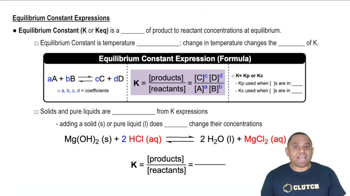
Equilibrium Constant (Kc)
The equilibrium constant (Kc) is a numerical value that expresses the ratio of the concentrations of products to reactants at equilibrium for a given reaction at a specific temperature. It is calculated using the formula Kc = [products]^[coefficients] / [reactants]^[coefficients]. A Kc value greater than 1 indicates that products are favored at equilibrium, while a value less than 1 suggests that reactants are favored.
Video consigliato:
Percorso guidato
Equilibrium Constant Expressions
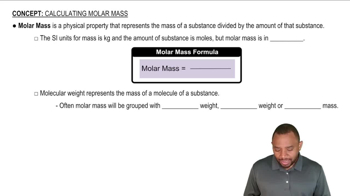
Molar Mass and Conversion to Molarity
To calculate Kc, it is essential to convert the mass of each substance in the reaction to moles using their molar masses. Molarity, defined as moles of solute per liter of solution, is then determined by dividing the number of moles by the volume of the flask in liters. This conversion is crucial for accurately determining the concentrations of reactants and products at equilibrium.
Video consigliato:
Percorso guidato
Molar Mass Concept
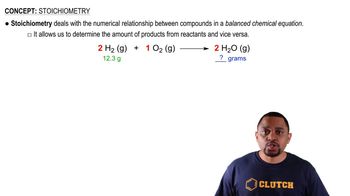
Stoichiometry of the Reaction
Stoichiometry involves the quantitative relationships between the reactants and products in a chemical reaction. In the given reaction, the coefficients indicate that one mole of CO reacts with two moles of H2 to produce one mole of CH3OH. Understanding these ratios is vital for calculating the changes in concentrations as the system reaches equilibrium and for determining the equilibrium constant.
Video consigliato:
Percorso guidato
Stoichiometry Concept
Pratica correlata
Domanda del libro di testo
3739
views
Domanda del libro di testo
Consider the reaction and the associated equilibrium constant: aA(g) ⇌ bB(g) Kc = 4.0 Find the equilibrium concentrations of A and B for each value of a and b. Assume that the initial concentration of A in each case is 1.0 M and that no B is present at the beginning of the reaction. c. a=1;b=2
2239
views
1
rank
Domanda del libro di testo
Silver sulfate dissolves in water according to the reaction: Ag2SO4(s) ⇌ 2 Ag+(aq) + SO42-(aq) Kc = 1.1⨉10-5 at 298 K. A 1.5-L solution contains 6.55 g of dissolved silver sulfate. If additional solid silver sulfate is added to the solution, will it dissolve?
5121
views
