Ch.10 - Chemical Bonding I: The Lewis Model
Tro - Chemistry: A Molecular Approach 6th Edition
Tro6th EditionChemistry: A Molecular ApproachISBN: 9780137832217Non è quello che usi tu?Cambia libro di testo
Capitolo 10, Problema 59a

Determine if a bond between each pair of atoms would be pure covalent, polar covalent, or ionic. a. Ba and O

Guida verificata passo dopo passo
1
Identify the types of elements involved: Barium (Ba) is a metal and Oxygen (O) is a non-metal.
Recall the general rule: bonds between metals and non-metals are typically ionic.
Consider the electronegativity difference: Ionic bonds usually form when the difference in electronegativity between the two atoms is greater than 1.7.
Look up the electronegativity values: Barium has an electronegativity of about 0.89 and Oxygen has an electronegativity of about 3.44.
Calculate the electronegativity difference: Subtract the electronegativity of Ba from that of O to determine if the bond is ionic.

Risposta video verificata per un problema simile:

Questa soluzione video è stata consigliata dai nostri tutor come utile per risolvere questo problema.

Concetti chiave

Ecco i concetti essenziali che devi comprendere per rispondere correttamente alla domanda.

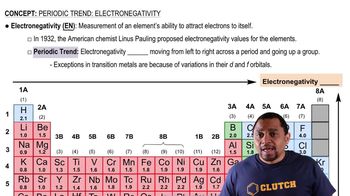
Electronegativity

Electronegativity is a measure of an atom's ability to attract and hold onto electrons in a chemical bond. The difference in electronegativity between two atoms determines the type of bond formed: a large difference typically indicates an ionic bond, while a smaller difference suggests covalent bonding. Understanding electronegativity is crucial for predicting bond characteristics.
Video consigliato:
Percorso guidato
02:10
Electronegativity Trends

Types of Chemical Bonds

Chemical bonds can be classified into three main types: ionic, polar covalent, and pure covalent. Ionic bonds occur between atoms with a significant electronegativity difference, leading to electron transfer. Polar covalent bonds form when electrons are shared unequally, while pure covalent bonds involve equal sharing of electrons. Recognizing these types helps in determining the nature of the bond between specific atoms.
Video consigliato:

Ionic vs. Covalent Bonds

Ionic bonds result from the electrostatic attraction between oppositely charged ions, typically formed between metals and nonmetals. In contrast, covalent bonds involve the sharing of electron pairs between atoms. The distinction between these bond types is essential for predicting the properties of compounds, such as solubility and conductivity, which are influenced by the nature of the bonding.
Video consigliato:
Percorso guidato
01:16
Chemical Bonds Example 1