Ch.10 - Chemical Bonding I: The Lewis Model
Tro - Chemistry: A Molecular Approach 6th Edition
Tro6th EditionChemistry: A Molecular ApproachISBN: 9780137832217Non è quello che usi tu?Cambia libro di testo
Capitolo 10, Problema 62a

Draw the Lewis structure for ClF with an arrow representing the dipole moment.

Guida verificata passo dopo passo
1
Identify the total number of valence electrons: Chlorine (Cl) has 7 valence electrons and Fluorine (F) also has 7 valence electrons, making a total of 14 valence electrons.
Determine the central atom: In a diatomic molecule like ClF, there is no central atom, so we will arrange Cl and F linearly.
Draw a single bond between Cl and F: This bond will use 2 of the 14 valence electrons, leaving us with 12 valence electrons.
Distribute the remaining electrons to satisfy the octet rule: Place 6 electrons (3 lone pairs) around each atom to complete their octets.
Indicate the dipole moment: Since fluorine is more electronegative than chlorine, draw an arrow pointing from Cl to F, indicating the direction of the dipole moment.

Risposta video verificata per un problema simile:

Questa soluzione video è stata consigliata dai nostri tutor come utile per risolvere questo problema.
Durata del video:
2m

Concetti chiave

Ecco i concetti essenziali che devi comprendere per rispondere correttamente alla domanda.

Lewis Structures

Lewis structures are diagrams that represent the bonding between atoms in a molecule and the lone pairs of electrons that may exist. They use dots to represent valence electrons and lines to represent bonds between atoms. Understanding how to draw Lewis structures is essential for visualizing molecular geometry and predicting the behavior of molecules.
Video consigliato:
Percorso guidato
04:28
Lewis Dot Structures: Ions

Electronegativity

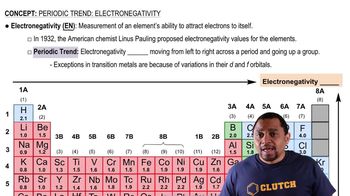
Electronegativity is a measure of an atom's ability to attract and hold onto electrons in a chemical bond. In the case of ClF, chlorine and fluorine have different electronegativities, with fluorine being more electronegative. This difference leads to the formation of a polar bond, where the electron density is unevenly distributed, resulting in a dipole moment.
Video consigliato:
Percorso guidato
02:10
Electronegativity Trends

Dipole Moment

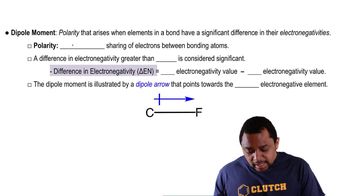
A dipole moment is a vector quantity that represents the separation of positive and negative charges in a molecule. It is indicated by an arrow pointing from the positive end to the negative end of the bond. In ClF, the dipole moment arises due to the difference in electronegativity between chlorine and fluorine, which creates a polar bond and influences the molecule's overall polarity.
Video consigliato: