
Ch.15 - Chemical Kinetics
Tro - Chemistry: A Molecular Approach 6th Edition
Tro6th EditionChemistry: A Molecular ApproachISBN: 9780137832217Non è quello che usi tu?Cambia libro di testo
Capitolo 15, Problema 35a(ii)

Consider the reaction: H2(g) + Br2(g) → 2 HBr(g). The graph shows the concentration of Br2 as a function of time. a. Use the graph to calculate each quantity: (ii) the instantaneous rate of the reaction at 25 s.

Guida verificata passo dopo passo
1
Identify the concentration of Br₂ at times just before and just after 25 seconds from the graph to estimate the change in concentration around that point.
Calculate the change in concentration of Br₂ (Δ[Br₂]) by subtracting the concentration at the later time from the concentration at the earlier time, since Br₂ is being consumed.
Determine the change in time (Δt) corresponding to the concentration change, using the time interval around 25 seconds.
Calculate the instantaneous rate of the reaction at 25 s by finding the slope of the tangent to the concentration vs. time curve at 25 s, which can be approximated by Δ[Br₂]/Δt over the small interval around 25 s.
Express the rate as a positive value and remember that the rate of disappearance of Br₂ is related to the rate of the reaction; since the reaction consumes Br₂, the rate = - (d[Br₂]/dt).

Concetti chiave

Ecco i concetti essenziali che devi comprendere per rispondere correttamente alla domanda.

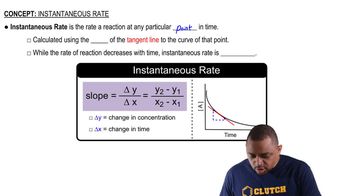
Instantaneous Rate of Reaction

The instantaneous rate of a reaction is the rate at a specific moment in time, found by determining the slope of the tangent line to the concentration vs. time curve at that point. It reflects how fast the concentration of a reactant or product changes at that exact time.
Video consigliato:
Percorso guidato
01:30
Instantaneous Rate

Concentration vs. Time Graph Interpretation

A concentration vs. time graph shows how the amount of a reactant or product changes during a reaction. The slope of the curve at any point indicates the rate of change of concentration, which is essential for calculating reaction rates.
Video consigliato:
Percorso guidato
03:12
Precipitation: Ksp vs Q Example

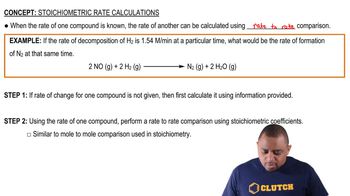
Rate of Reaction and Stoichiometry

The rate of reaction is often expressed in terms of the change in concentration of reactants or products per unit time, adjusted by their stoichiometric coefficients. Understanding the balanced equation helps relate the rate of disappearance of Br2 to the overall reaction rate.
Video consigliato:
Percorso guidato
02:28
Stoichiometric Rate Calculations