Ch.17 - Acids and Bases
Tro - Chemistry: A Molecular Approach 6th Edition
Tro6th EditionChemistry: A Molecular ApproachISBN: 9780137832217Non è quello che usi tu?Cambia libro di testo
Capitolo 17, Problema 76

Determine the percent ionization of a 0.250 M solution of benzoic acid.

Guida verificata passo dopo passo
1
Identify the chemical formula for benzoic acid, which is C6H5COOH, and recognize that it is a weak acid that partially ionizes in solution.
Write the ionization equation for benzoic acid: C6H5COOH (aq) ⇌ C6H5COO⁻ (aq) + H⁺ (aq).
Use the expression for the acid dissociation constant (Ka) for benzoic acid: Ka = [C6H5COO⁻][H⁺] / [C6H5COOH].
Assume that the initial concentration of benzoic acid is 0.250 M and that the change in concentration due to ionization is 'x', then set up the expression: Ka = (x)(x) / (0.250 - x).
Solve for 'x', which represents the concentration of ionized benzoic acid, and calculate the percent ionization using the formula: (x / 0.250) * 100%.

Risposta video verificata per un problema simile:

Questa soluzione video è stata consigliata dai nostri tutor come utile per risolvere questo problema.
Durata del video:
3m

Concetti chiave

Ecco i concetti essenziali che devi comprendere per rispondere correttamente alla domanda.

Ionization of Acids

Ionization refers to the process by which an acid donates protons (H+) to water, forming hydronium ions (H3O+) and its conjugate base. For weak acids like benzoic acid, this process is not complete, and only a fraction of the acid molecules ionize in solution. Understanding this concept is crucial for calculating the percent ionization.
Video consigliato:
Percorso guidato
01:15
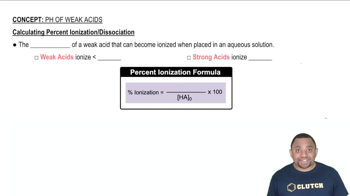
Calculating Percent Ionization of Weak Acids

Percent Ionization

Percent ionization is a measure of the extent to which an acid ionizes in solution, expressed as a percentage. It is calculated using the formula: (concentration of ionized acid / initial concentration of acid) × 100%. This concept helps in comparing the strength of different acids and understanding their behavior in solution.
Video consigliato:
Percorso guidato
06:08
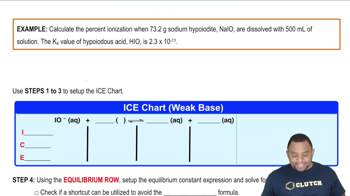
Percent Ionization Example

Equilibrium Constant (Ka)

The acid dissociation constant (Ka) quantifies the strength of a weak acid in solution. It is defined as the ratio of the concentration of the products (ionized form) to the concentration of the reactants (non-ionized form) at equilibrium. Knowing the Ka value for benzoic acid is essential for calculating the degree of ionization and, consequently, the percent ionization.
Video consigliato:
Percorso guidato
01:14
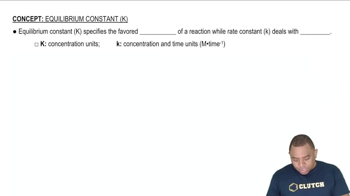
Equilibrium Constant K