Ch.18 - Aqueous Ionic Equilibrium
Tro - Chemistry: A Molecular Approach 6th Edition
Tro6th EditionChemistry: A Molecular ApproachISBN: 9780137832217Non è quello che usi tu?Cambia libro di testo
Capitolo 18, Problema 28

A formic acid solution has a pH of 3.25. Which of these substances will raise the pH of the solution upon addition? Explain your answer. a. HCl b. NaBr c. NaCHO2 d. KCl

Guida verificata passo dopo passo
1
insert step 1: Understand that pH is a measure of the acidity or basicity of a solution. A lower pH indicates a more acidic solution, while a higher pH indicates a more basic solution.
insert step 2: Recognize that adding a strong acid like HCl will lower the pH further, making the solution more acidic.
insert step 3: Identify that NaBr and KCl are salts of strong acids and strong bases, which are neutral in solution and will not significantly change the pH.
insert step 4: Note that NaCHO2 (sodium formate) is the salt of a weak acid (formic acid) and a strong base (sodium hydroxide). It will act as a weak base in solution, raising the pH.
insert step 5: Conclude that adding NaCHO2 will raise the pH of the formic acid solution, as it will partially neutralize the acid, making the solution less acidic.

Risposta video verificata per un problema simile:

Questa soluzione video è stata consigliata dai nostri tutor come utile per risolvere questo problema.
Durata del video:
1m

Concetti chiave

Ecco i concetti essenziali che devi comprendere per rispondere correttamente alla domanda.

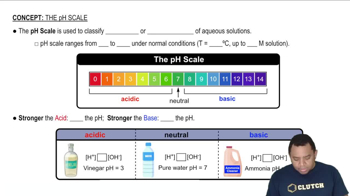
pH Scale

The pH scale measures the acidity or basicity of a solution, ranging from 0 to 14. A pH of 7 is neutral, below 7 indicates acidity, and above 7 indicates basicity. In this context, a solution with a pH of 3.25 is acidic, meaning it has a higher concentration of hydrogen ions (H+) compared to hydroxide ions (OH-). Understanding the pH scale is essential for determining how different substances will affect the acidity or basicity of the solution.
Video consigliato:

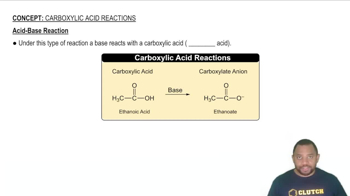
Acid-Base Reactions

Acid-base reactions involve the transfer of protons (H+) between substances. Acids donate protons, while bases accept them. When a base is added to an acidic solution, it can neutralize some of the hydrogen ions, thereby increasing the pH. Identifying whether a substance is an acid or a base is crucial for predicting its effect on the pH of the solution.
Video consigliato:
Percorso guidato
01:09
Acid-Base Reaction

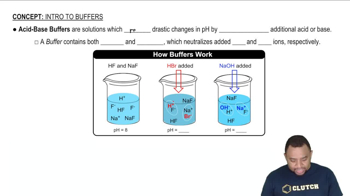
Buffer Solutions

Buffer solutions resist changes in pH when small amounts of acid or base are added. They typically consist of a weak acid and its conjugate base or a weak base and its conjugate acid. In the case of formic acid, which is a weak acid, the addition of a conjugate base (like sodium formate, NaCHO2) can help raise the pH by neutralizing excess H+ ions, making it important to recognize the role of buffers in pH changes.
Video consigliato:
Percorso guidato
03:02
Buffer Solutions