Ch.18 - Aqueous Ionic Equilibrium
Tro - Chemistry: A Molecular Approach 6th Edition
Tro6th EditionChemistry: A Molecular ApproachISBN: 9780137832217Non è quello che usi tu?Cambia libro di testo
Capitolo 18, Problema 29a

Solve an equilibrium problem (using an ICE table) to calculate the pH of each solution. a. a solution that is 0.25 M in NH3 and 0.18 M in NH4Cl

Guida verificata passo dopo passo
1
Identify the chemical reaction involved: NH3 (aq) + H2O (l) ⇌ NH4+ (aq) + OH- (aq).
Write the expression for the equilibrium constant (Kb) for the reaction: Kb = [NH4+][OH-] / [NH3].
Set up an ICE table (Initial, Change, Equilibrium) to track the concentrations of NH3, NH4+, and OH-.
Use the initial concentrations: [NH3] = 0.25 M, [NH4+] = 0.18 M, and [OH-] = 0 M. Assume a change of 'x' for the reaction to reach equilibrium.
Solve for 'x' using the Kb value for NH3 and the equilibrium expression, then calculate the pOH and convert it to pH using the relation: pH + pOH = 14.

Risposta video verificata per un problema simile:

Questa soluzione video è stata consigliata dai nostri tutor come utile per risolvere questo problema.
Durata del video:
5m

Concetti chiave

Ecco i concetti essenziali che devi comprendere per rispondere correttamente alla domanda.

Equilibrium and ICE Tables

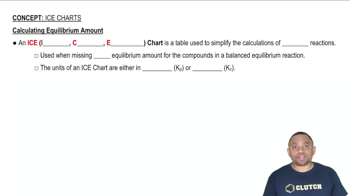
Equilibrium in chemistry refers to the state where the concentrations of reactants and products remain constant over time. An ICE table (Initial, Change, Equilibrium) is a tool used to organize the concentrations of species involved in a reaction at different stages. It helps in calculating the changes in concentration as the system reaches equilibrium, which is essential for solving equilibrium problems.
Video consigliato:
Percorso guidato
01:14
ICE Charts and Equilibrium Amount

Weak Bases and Conjugate Acids

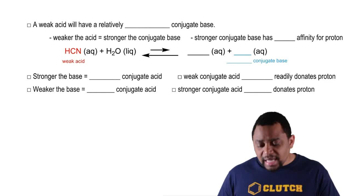
Ammonia (NH3) is a weak base that partially ionizes in water to form hydroxide ions (OH-) and ammonium ions (NH4+). The presence of NH4Cl provides the conjugate acid (NH4+) of the weak base, which influences the pH of the solution. Understanding the relationship between weak bases and their conjugate acids is crucial for calculating the pH in buffer solutions.
Video consigliato:
Percorso guidato
01:46
Conjugate Acid-Base Relationships

Henderson-Hasselbalch Equation

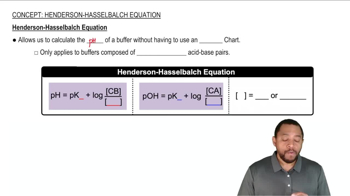
The Henderson-Hasselbalch equation is a mathematical formula used to calculate the pH of buffer solutions. It relates the pH of a solution to the pKa of the weak acid and the ratio of the concentrations of the conjugate base and acid. This equation is particularly useful in equilibrium problems involving weak acids and bases, allowing for quick pH estimations based on concentration values.
Video consigliato:
Percorso guidato
02:40
Henderson-Hasselbalch Equation