Solve an equilibrium problem (using an ICE table) to calculate the pH of each solution. c. a mixture that is 0.15 M in HF and 0.15 M in NaF
Ch.18 - Aqueous Ionic Equilibrium

Tro6th EditionChemistry: A Molecular ApproachISBN: 9780137832217Non è quello che usi tu?Cambia libro di testo
Capitolo 18, Problema 31
Calculate the percent ionization of a 0.20 M benzoic acid solution in pure water and in a solution containing 0.25 M sodium benzoate. Why does the percent ionization differ significantly in the two solutions?
Guida verificata passo dopo passo1
insert step 1: Write the chemical equation for the ionization of benzoic acid (C6H5COOH) in water: C6H5COOH (aq) ⇌ C6H5COO⁻ (aq) + H⁺ (aq).
insert step 2: Use the expression for the acid dissociation constant (Ka) for benzoic acid: Ka = [C6H5COO⁻][H⁺] / [C6H5COOH].
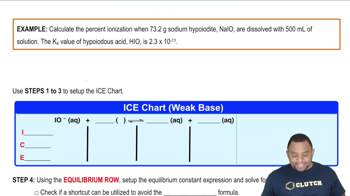
insert step 3: For the pure water solution, set up an ICE table (Initial, Change, Equilibrium) to find the equilibrium concentrations of the species involved. Assume initial concentration of benzoic acid is 0.20 M and initial concentrations of C6H5COO⁻ and H⁺ are 0.
insert step 4: For the solution containing sodium benzoate, recognize that sodium benzoate is a salt that provides a common ion (C6H5COO⁻). Use the common ion effect to adjust the ICE table, starting with an initial concentration of 0.25 M for C6H5COO⁻.
insert step 5: Calculate the percent ionization for both scenarios using the formula: Percent Ionization = ([H⁺] / Initial [C6H5COOH]) * 100%. Compare the results to understand the effect of the common ion on ionization.

Risposta video verificata per un problema simile:
Questa soluzione video è stata consigliata dai nostri tutor come utile per risolvere questo problema.
Durata del video:
6mConcetti chiave
Ecco i concetti essenziali che devi comprendere per rispondere correttamente alla domanda.
Ionization of Weak Acids
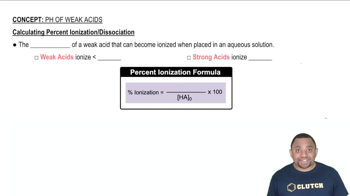
Weak acids, like benzoic acid, do not completely dissociate in solution. Instead, they establish an equilibrium between the undissociated acid and its ions. The degree of ionization is influenced by the acid's strength, which is quantified by its acid dissociation constant (Ka). Understanding this equilibrium is crucial for calculating percent ionization.
Video consigliato:
Percorso guidato
Calculating Percent Ionization of Weak Acids
Percent Ionization
Percent ionization is a measure of the extent to which an acid dissociates in solution, expressed as the ratio of the concentration of ionized acid to the initial concentration, multiplied by 100. It provides insight into the strength of the acid in different environments, helping to compare how factors like concentration and the presence of other solutes affect ionization.
Video consigliato:
Percorso guidato
Percent Ionization Example
Common Ion Effect
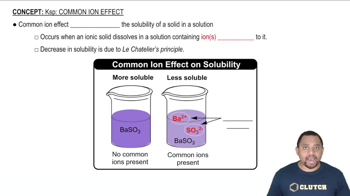
The common ion effect occurs when a salt containing an ion in common with a weak acid is added to the solution, shifting the equilibrium position according to Le Chatelier's principle. In the case of benzoic acid and sodium benzoate, the presence of benzoate ions from sodium benzoate suppresses the ionization of benzoic acid, leading to a lower percent ionization in the mixed solution compared to pure water.
Video consigliato:
Percorso guidato
Common Ion Effect
Pratica correlata
Domanda del libro di testo
1766
views
Domanda del libro di testo
A formic acid solution has a pH of 3.25. Which of these substances will raise the pH of the solution upon addition? Explain your answer. a. HCl b. NaBr c. NaCHO2 d. KCl
2806
views
1
rank
Domanda del libro di testo
Solve an equilibrium problem (using an ICE table) to calculate the pH of each solution. a. 0.15 M HF
1231
views
Domanda del libro di testo
Solve an equilibrium problem (using an ICE table) to calculate the pH of each solution. b. 0.15 M NaF
508
views
Domanda del libro di testo
Solve an equilibrium problem (using an ICE table) to calculate the pH of each solution. b solution that is 0.15 M in HCHO2 and 0.25 M in NaCHO2
Domanda del libro di testo
Solve an equilibrium problem (using an ICE table) to calculate the pH of each solution. a. a solution that is 0.25 M in NH3 and 0.18 M in NH4Cl