Ch. 10 - DNA Replication
Klug - Essentials of Genetics 10th Edition
Klug10th EditionEssentials of GeneticsISBN: 9780135588789Non è quello che usi tu?Cambia libro di testo
Capitolo 10, Problema 4

Describe the role of ¹⁵N in the Meselson–Stahl experiment.

Guida verificata passo dopo passo
1
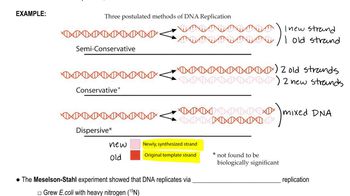
Understand that the Meselson–Stahl experiment was designed to determine the mechanism of DNA replication, specifically whether it is conservative, semi-conservative, or dispersive.
Recognize that ¹⁵N (nitrogen-15) is a heavy isotope of nitrogen used to label the DNA of bacteria by growing them in a medium containing ¹⁵N, which gets incorporated into the nitrogenous bases of DNA.
Note that after several generations in ¹⁵N medium, the DNA becomes 'heavy' due to the incorporation of ¹⁵N, allowing it to be distinguished from 'light' DNA containing the more common ¹⁴N isotope by density gradient centrifugation.
Observe that when bacteria are transferred from ¹⁵N medium to ¹⁴N medium and allowed to replicate, the distribution of DNA densities after replication can be analyzed to infer the replication mechanism.
Conclude that the role of ¹⁵N is to serve as a molecular marker that enables the separation and identification of DNA molecules based on their density, which is critical for interpreting the results of the Meselson–Stahl experiment.

Risposta video verificata per un problema simile:

Questa soluzione video è stata consigliata dai nostri tutor come utile per risolvere questo problema.
Durata del video:
1m

Concetti chiave

Ecco i concetti essenziali che devi comprendere per rispondere correttamente alla domanda.

Isotopic Labeling with ¹⁵N

¹⁵N is a stable heavy isotope of nitrogen used to label DNA molecules. In the Meselson–Stahl experiment, bacteria were grown in a medium containing ¹⁵N, causing their DNA to incorporate this heavier isotope, which allowed differentiation between old and new DNA strands based on density.
Video consigliato:
Percorso guidato
05:34
Bacteriophage Regulation

Density Gradient Centrifugation

This technique separates molecules based on their density by spinning them in a cesium chloride gradient. DNA containing ¹⁵N is denser and forms a distinct band lower in the gradient compared to DNA with the lighter ¹⁴N, enabling visualization of DNA replication patterns.
Video consigliato:
Percorso guidato
03:52
Cell-cell interactions

Semiconservative DNA Replication

The Meselson–Stahl experiment demonstrated that DNA replication is semiconservative, meaning each new DNA molecule consists of one old (¹⁵N-labeled) strand and one newly synthesized (¹⁴N) strand. The use of ¹⁵N allowed tracking of parental and daughter strands to confirm this model.
Video consigliato:
Percorso guidato
14:31
Semiconservative Replication