
Ch. 10 - DNA Replication
Klug - Essentials of Genetics 10th Edition
Klug10th EditionEssentials of GeneticsISBN: 9780135588789Non è quello che usi tu?Cambia libro di testo
Capitolo 10, Problema 20c

Several temperature-sensitive mutant strains of E. coli display the following characteristics. Predict what enzyme or function is being affected by each mutation.
No initiation occurs.

Guida verificata passo dopo passo
1
Step 1: Understand the biological context — the problem involves temperature-sensitive mutants of E. coli that show no initiation of a process, likely DNA replication or transcription, at the non-permissive temperature.
Step 2: Identify what 'no initiation occurs' means — in molecular biology, initiation refers to the beginning step of processes like DNA replication or transcription, where specific proteins or enzymes bind to DNA to start the process.
Step 3: Recall key enzymes involved in initiation — for DNA replication in E. coli, initiation requires the DnaA protein binding to the origin of replication (oriC) to unwind DNA and recruit other proteins; for transcription, initiation requires RNA polymerase binding to the promoter region.
Step 4: Analyze which enzyme or function is likely affected — since no initiation occurs, the mutation probably affects the protein responsible for recognizing the start site and beginning the process, such as DnaA for replication initiation or RNA polymerase for transcription initiation.
Step 5: Conclude that the mutation likely affects the initiation factor or enzyme (e.g., DnaA protein for replication initiation) that is essential for starting the process, preventing the cell from initiating DNA replication or transcription at the restrictive temperature.

Risposta video verificata per un problema simile:

Questa soluzione video è stata consigliata dai nostri tutor come utile per risolvere questo problema.
Durata del video:
2m

Concetti chiave

Ecco i concetti essenziali che devi comprendere per rispondere correttamente alla domanda.

Temperature-Sensitive Mutations

Temperature-sensitive mutations cause proteins to function normally at a permissive temperature but lose function at a restrictive, usually higher, temperature. These mutations help identify essential genes or enzymes by observing which cellular processes fail when the temperature shifts.
Video consigliato:
Percorso guidato
10:48
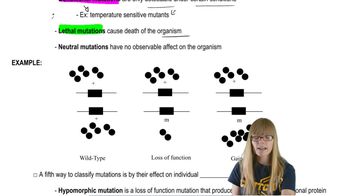
Mutations and Phenotypes

Initiation of DNA Replication in E. coli

Initiation of DNA replication in E. coli involves the assembly of a protein complex at the origin of replication (oriC), including DnaA binding to initiate unwinding. Proper function of initiator proteins and helicases is critical to start replication; defects here prevent initiation.
Video consigliato:
Percorso guidato
11:59
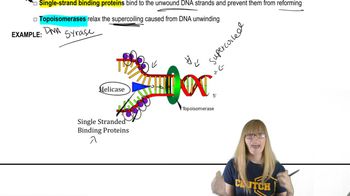
Steps to DNA Replication

Role of Enzymes in DNA Replication Initiation

Key enzymes like DnaA (initiator), DnaB (helicase), and DnaC (helicase loader) coordinate to open the DNA helix and recruit DNA polymerase. Mutations affecting these enzymes can block initiation, causing no replication to start, which explains the phenotype of no initiation in mutant strains.
Video consigliato:
Percorso guidato
11:59
Steps to DNA Replication
Pratica correlata
Domanda del libro di testo

Several temperature-sensitive mutant strains of E. coli display the following characteristics. Predict what enzyme or function is being affected by each mutation.

Newly synthesized DNA contains many mismatched base pairs.

669
views
Domanda del libro di testo

Several temperature-sensitive mutant strains of E. coli display the following characteristics. Predict what enzyme or function is being affected by each mutation.

Okazaki fragments accumulate, and DNA synthesis is never completed.

664
views
Domanda del libro di testo

Several temperature-sensitive mutant strains of E. coli display the following characteristics. Predict what enzyme or function is being affected by each mutation.

Synthesis is very slow.

651
views
Domanda del libro di testo

Several temperature-sensitive mutant strains of E. coli display the following characteristics. Predict what enzyme or function is being affected by each mutation.

Supercoiled strands remain after replication, which is never completed.

706
views
Domanda del libro di testo

Many of the gene products involved in DNA synthesis were initially defined by studying mutant E. coli strains that could not synthesize DNA.

The dnaE gene encodes the α subunit of DNA polymerase III. What effect is expected from a mutation in this gene? How could the mutant strain be maintained?

614
views
Domanda del libro di testo

Why is DNA synthesis expected to be more complex in eukaryotes than in bacteria? How is DNA synthesis similar in the two types of organisms?

912
views