Ch. 10 - DNA Replication
Klug - Essentials of Genetics 10th Edition
Klug10th EditionEssentials of GeneticsISBN: 9780135588789Non è quello che usi tu?Cambia libro di testo
Capitolo 10, Problema 20e

Several temperature-sensitive mutant strains of E. coli display the following characteristics. Predict what enzyme or function is being affected by each mutation.
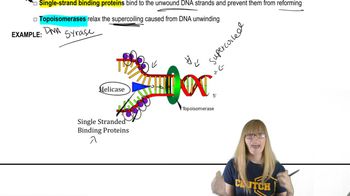
Supercoiled strands remain after replication, which is never completed.

Guida verificata passo dopo passo
1
Understand the biological context: In DNA replication, the DNA strands become supercoiled ahead of the replication fork due to the unwinding of the double helix.
Recall the role of enzymes that manage DNA supercoiling during replication. Specifically, DNA gyrase (a type of topoisomerase) introduces negative supercoils to relieve the positive supercoiling tension.
Analyze the problem statement: 'Supercoiled strands remain after replication, which is never completed.' This suggests that the enzyme responsible for relieving supercoiling is not functioning properly.
Identify that if supercoiling is not resolved, the replication machinery cannot proceed efficiently, leading to incomplete replication.
Conclude that the mutation likely affects the gene encoding DNA gyrase (topoisomerase II), which is essential for removing supercoils during replication.

Risposta video verificata per un problema simile:

Questa soluzione video è stata consigliata dai nostri tutor come utile per risolvere questo problema.
Durata del video:
2m

Concetti chiave

Ecco i concetti essenziali che devi comprendere per rispondere correttamente alla domanda.

DNA Replication Process

DNA replication is the process by which a cell duplicates its DNA before cell division. It involves unwinding the double helix, synthesizing new strands, and resolving topological stress to ensure complete and accurate copying of genetic material.
Video consigliato:
Percorso guidato
11:59
Steps to DNA Replication

Role of DNA Topoisomerases

DNA topoisomerases are enzymes that manage DNA supercoiling and relieve torsional strain during replication. They cut and rejoin DNA strands to prevent overwinding, allowing replication forks to progress smoothly and replication to complete.
Video consigliato:
Percorso guidato
11:59
Steps to DNA Replication

Temperature-Sensitive Mutations

Temperature-sensitive mutations produce proteins that function normally at permissive temperatures but lose activity at restrictive (higher) temperatures. This allows study of essential genes by observing defects, such as incomplete replication due to enzyme malfunction, under non-permissive conditions.
Video consigliato:
Percorso guidato
10:48
Mutations and Phenotypes
Pratica correlata
Domanda del libro di testo

Several temperature-sensitive mutant strains of E. coli display the following characteristics. Predict what enzyme or function is being affected by each mutation.

Okazaki fragments accumulate, and DNA synthesis is never completed.

664
views
Domanda del libro di testo

Several temperature-sensitive mutant strains of E. coli display the following characteristics. Predict what enzyme or function is being affected by each mutation.

Synthesis is very slow.

651
views
Domanda del libro di testo

Many of the gene products involved in DNA synthesis were initially defined by studying mutant E. coli strains that could not synthesize DNA.

The dnaQ gene encodes the ε subunit of DNA polymerase. What effect is expected from a mutation in this gene?

491
views
Domanda del libro di testo

Many of the gene products involved in DNA synthesis were initially defined by studying mutant E. coli strains that could not synthesize DNA.

The dnaE gene encodes the α subunit of DNA polymerase III. What effect is expected from a mutation in this gene? How could the mutant strain be maintained?

614
views
Domanda del libro di testo

Several temperature-sensitive mutant strains of E. coli display the following characteristics. Predict what enzyme or function is being affected by each mutation.

No initiation occurs.

743
views
Domanda del libro di testo

Assume a hypothetical organism in which DNA replication is conservative. Design an experiment similar to that of Taylor, Woods, and Hughes that will unequivocally establish this fact. Using the format established in Figure 11.5, draw sister chromatids and illustrate the expected results establishing this mode of replication.

805
views