Ch. 12 - The Genetic Code and Transcription
Klug - Essentials of Genetics 10th Edition
Klug10th EditionEssentials of GeneticsISBN: 9780135588789Non è quello che usi tu?Cambia libro di testo
Capitolo 12, Problema 15b

Refer to the genetic coding dictionary to respond to the following:
A base-substitution mutation that altered the sequence shown in part (a) eliminated the synthesis of all but one polypeptide. The altered sequence is shown here:
5'-AUGCAUACCUAUGUGACCCUUGGA-3'
Determine why.

Guida verificata passo dopo passo
1
Identify the original mRNA sequence from part (a) to compare it with the altered sequence provided: 5'-AUGCAUACCUAUGUGACCCUUGGA-3'.
Divide the altered mRNA sequence into codons (groups of three nucleotides) to understand which amino acids are encoded: for example, AUG, CAU, ACC, etc.
Use the genetic code dictionary to translate each codon into its corresponding amino acid or stop signal.
Look for any codon in the altered sequence that corresponds to a stop codon (UAA, UAG, or UGA), which would terminate translation prematurely and thus eliminate synthesis of polypeptides beyond that point.
Explain how the base-substitution mutation introduced a premature stop codon, causing the ribosome to stop translation early and resulting in only one polypeptide being synthesized.

Risposta video verificata per un problema simile:

Questa soluzione video è stata consigliata dai nostri tutor come utile per risolvere questo problema.
Durata del video:
1m

Concetti chiave

Ecco i concetti essenziali che devi comprendere per rispondere correttamente alla domanda.

Genetic Code and Codon-Anticodon Relationship

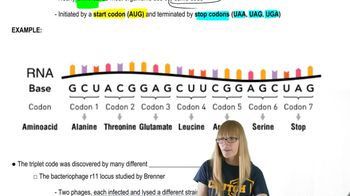
The genetic code consists of nucleotide triplets called codons, each specifying an amino acid or a stop signal during protein synthesis. Understanding how codons translate into amino acids is essential to determine how mutations affect polypeptide formation.
Video consigliato:
Percorso guidato
11:43
The Genetic Code

Base-Substitution Mutation Effects

A base-substitution mutation replaces one nucleotide with another, potentially altering a codon. This can lead to silent, missense, or nonsense mutations, with nonsense mutations introducing premature stop codons that truncate protein synthesis.
Video consigliato:
Percorso guidato
03:38
Maternal Effect

Translation Termination and Polypeptide Synthesis

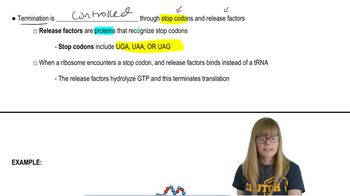
Translation ends when a stop codon is encountered, signaling the ribosome to release the polypeptide. If a mutation creates an early stop codon, it can halt synthesis prematurely, explaining why only one polypeptide is produced from the altered sequence.
Video consigliato:
Percorso guidato
01:55
Translation Termination