Ch. 16 - Regulation of Gene Expression in Eukaryotes
Klug - Essentials of Genetics 10th Edition
Klug10th EditionEssentials of GeneticsISBN: 9780135588789Non è quello che usi tu?Cambia libro di testo
Capitolo 16, Problema 5

Provide a brief description of two different types of histone modification and how they impact transcription.

Guida verificata passo dopo passo
1
Step 1: Understand that histone modifications are chemical changes to the histone proteins around which DNA is wrapped, affecting how tightly or loosely DNA is packaged and thus influencing gene expression.
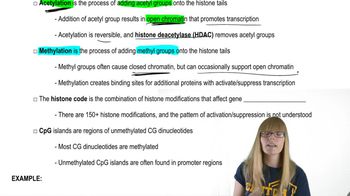
Step 2: Describe acetylation, a type of histone modification where an acetyl group is added to lysine residues on histone tails. This reduces the positive charge on histones, decreasing their affinity for negatively charged DNA, leading to a more relaxed chromatin structure and generally promoting transcription.
Step 3: Describe methylation, another histone modification where methyl groups are added to lysine or arginine residues on histones. Depending on the specific site and degree of methylation, this can either activate or repress transcription by altering chromatin structure or recruiting regulatory proteins.
Step 4: Explain that acetylation is typically associated with transcriptional activation because it opens up chromatin, making DNA more accessible to transcription factors and RNA polymerase.
Step 5: Explain that methylation can have dual effects: for example, trimethylation of histone H3 at lysine 4 (H3K4me3) is linked to active transcription, while trimethylation at lysine 9 (H3K9me3) is associated with transcriptional repression and heterochromatin formation.

Risposta video verificata per un problema simile:

Questa soluzione video è stata consigliata dai nostri tutor come utile per risolvere questo problema.
Durata del video:
28s

Concetti chiave

Ecco i concetti essenziali che devi comprendere per rispondere correttamente alla domanda.

Histone Modification

Histone modifications are chemical changes to the histone proteins around which DNA is wrapped. These modifications, such as methylation or acetylation, alter chromatin structure and influence gene accessibility, thereby regulating transcriptional activity.
Video consigliato:
Percorso guidato
07:55
Histone Protein Modifications

Histone Acetylation

Histone acetylation involves adding acetyl groups to lysine residues on histone tails, which neutralizes positive charges and reduces histone-DNA interaction. This leads to a more relaxed chromatin structure, promoting transcription by allowing transcription factors easier access to DNA.
Video consigliato:
Percorso guidato
07:55
Histone Protein Modifications

Histone Methylation

Histone methylation adds methyl groups to specific lysine or arginine residues on histones. Depending on the site and degree of methylation, it can either activate or repress transcription by recruiting proteins that modify chromatin structure or interact with the transcription machinery.
Video consigliato:
Percorso guidato
07:55
Histone Protein Modifications