Ch. 3 - Mendelian Genetics
Klug - Essentials of Genetics 10th Edition
Klug10th EditionEssentials of GeneticsISBN: 9780135588789Non è quello che usi tu?Cambia libro di testo
Capitolo 3, Problema 19

What is the probability of obtaining a triply recessive individual from the parents shown in Problem 18.

Guida verificata passo dopo passo
1
Identify the genotypes of the parents given in Problem 18. Typically, this involves determining the alleles each parent carries for the three genes in question.
Determine the possible gametes each parent can produce by considering all combinations of alleles for the three genes. Use the principle of independent assortment if the genes are unlinked.
Calculate the probability that each parent contributes the recessive allele for each gene. For example, if a parent is heterozygous (Aa), the probability of passing the recessive allele (a) is 1/2; if homozygous recessive (aa), the probability is 1.
Multiply the probabilities for each gene from both parents to find the probability that the offspring is homozygous recessive (aa bb cc) for all three genes. This involves multiplying the probabilities of receiving recessive alleles from both parents for each gene.
Combine the probabilities for all three genes by multiplying them together to get the overall probability of obtaining a triply recessive individual.

Concetti chiave

Ecco i concetti essenziali che devi comprendere per rispondere correttamente alla domanda.

Mendelian Inheritance and Recessive Traits

Mendelian inheritance explains how traits are passed from parents to offspring through dominant and recessive alleles. A recessive trait is expressed only when an individual inherits two copies of the recessive allele. Understanding this helps determine the likelihood of offspring showing recessive phenotypes.
Video consigliato:
Percorso guidato
13:40
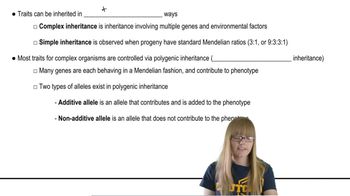
Traits and Variance

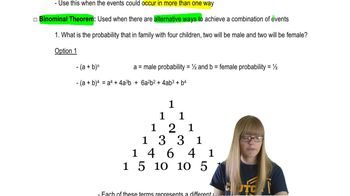
Probability in Genetics

Probability in genetics calculates the chance of inheriting specific allele combinations from parents. It involves multiplying the probabilities of independent events, such as inheriting recessive alleles from each gene, to find the overall likelihood of a particular genotype or phenotype.
Video consigliato:

Dihybrid and Trihybrid Crosses

Dihybrid and trihybrid crosses analyze inheritance patterns involving two or three genes, respectively. Each gene segregates independently, and the combined probability of recessive traits across multiple genes is found by multiplying individual gene probabilities, essential for determining triply recessive offspring.
Video consigliato:
Percorso guidato
26:08
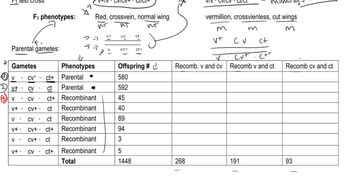
Trihybrid Cross