Ch. 6 - Chromosome Mutations: Variation in Number and Arrangement
Klug - Essentials of Genetics 10th Edition
Klug10th EditionEssentials of GeneticsISBN: 9780135588789Non è quello che usi tu?Cambia libro di testo
Capitolo 6, Problema 5

What evidence suggests that Down syndrome is more often the result of nondisjunction during oogenesis rather than during spermatogenesis?

Guida verificata passo dopo passo
1
Understand that Down syndrome is most commonly caused by trisomy 21, which results from nondisjunction, an error in chromosome separation during meiosis.
Recognize that oogenesis (egg formation) and spermatogenesis (sperm formation) are the two processes where nondisjunction can occur, leading to an abnormal number of chromosomes in the gametes.
Review cytogenetic studies and parental origin analyses of the extra chromosome 21 in individuals with Down syndrome, which often use molecular markers to determine whether the extra chromosome came from the mother or the father.
Note that a majority of these studies show the extra chromosome 21 is maternally derived, indicating nondisjunction occurred during oogenesis rather than spermatogenesis.
Consider biological factors such as the prolonged arrest of oocytes in meiosis I, which increases the chance of nondisjunction during egg formation, providing a mechanistic explanation for the maternal origin bias.

Risposta video verificata per un problema simile:

Questa soluzione video è stata consigliata dai nostri tutor come utile per risolvere questo problema.
Durata del video:
1m

Concetti chiave

Ecco i concetti essenziali che devi comprendere per rispondere correttamente alla domanda.

Nondisjunction

Nondisjunction is the failure of chromosome pairs to separate properly during cell division, leading to gametes with abnormal chromosome numbers. In the context of Down syndrome, nondisjunction results in an extra copy of chromosome 21, causing trisomy 21.
Video consigliato:

Oogenesis vs. Spermatogenesis

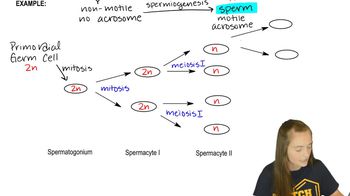
Oogenesis is the process of egg formation in females, characterized by long arrest phases and fewer cell divisions, while spermatogenesis is sperm formation in males, involving continuous and rapid cell divisions. These differences influence the likelihood of nondisjunction events.
Video consigliato:
Percorso guidato
21:21
Gamete Development

Parental Origin of Trisomy 21

Studies using genetic markers show that most cases of trisomy 21 originate from errors in the maternal egg rather than the paternal sperm. This evidence includes higher rates of nondisjunction during oogenesis, especially with increasing maternal age.
Video consigliato:
Percorso guidato
09:31
Robertsonian Translocations