Ch. 6 - Chromosome Mutations: Variation in Number and Arrangement
Klug - Essentials of Genetics 10th Edition
Klug10th EditionEssentials of GeneticsISBN: 9780135588789Non è quello che usi tu?Cambia libro di testo
Capitolo 6, Problema 3

Define these pairs of terms, and distinguish between them.
aneuploidy/ euploidy
monosomy/ trisomy
Patau syndrome/ Edwards syndrome
autopolyploidy/ allopolyploidy
autotetraploid/ amphidiploid
paracentric inversion/ pericentric inversion

Guida verificata passo dopo passo
1
Start by defining aneuploidy and euploidy: Aneuploidy refers to the presence of an abnormal number of chromosomes in a cell (not an exact multiple of the haploid number), while euploidy means having a chromosome number that is an exact multiple of the haploid set.
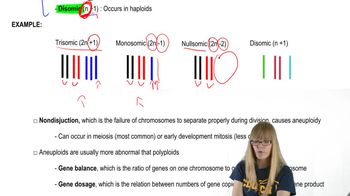
Next, define monosomy and trisomy: Monosomy is a type of aneuploidy where one chromosome is missing from the normal diploid set (2n - 1), whereas trisomy is when there is an extra chromosome present (2n + 1).
Then, explain Patau syndrome and Edwards syndrome: Patau syndrome is caused by trisomy of chromosome 13, characterized by severe intellectual disability and physical abnormalities; Edwards syndrome results from trisomy of chromosome 18, also causing developmental issues but with a different set of clinical features.
After that, distinguish autopolyploidy and allopolyploidy: Autopolyploidy occurs when multiple chromosome sets come from the same species (e.g., chromosome duplication within one species), while allopolyploidy involves combining chromosome sets from different species through hybridization.
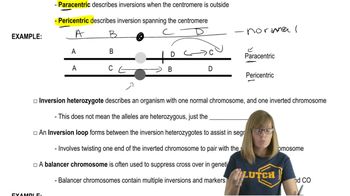
Finally, differentiate between paracentric and pericentric inversions: Paracentric inversion is a chromosome rearrangement that does not include the centromere and involves only one arm of the chromosome, whereas pericentric inversion includes the centromere and involves both arms.

Risposta video verificata per un problema simile:

Questa soluzione video è stata consigliata dai nostri tutor come utile per risolvere questo problema.
Durata del video:
1m

Concetti chiave

Ecco i concetti essenziali che devi comprendere per rispondere correttamente alla domanda.

Aneuploidy vs. Euploidy

Aneuploidy refers to the presence of an abnormal number of chromosomes in a cell, such as missing or extra chromosomes, disrupting the normal chromosome set. Euploidy describes cells with complete sets of chromosomes, either the normal diploid number or multiples thereof, maintaining genomic balance.
Video consigliato:

Monosomy vs. Trisomy

Monosomy is a type of aneuploidy where one chromosome from a pair is missing, resulting in a single copy instead of two. Trisomy involves having an extra chromosome, making three copies of a particular chromosome, which often leads to developmental disorders.
Video consigliato:
Percorso guidato
04:17
Traditional vs. Next-Gen

Paracentric Inversion vs. Pericentric Inversion

Paracentric inversion is a chromosome rearrangement where a segment flips within one arm of a chromosome, excluding the centromere. Pericentric inversion includes the centromere and involves flipping a chromosome segment that spans both arms, potentially affecting gene order and function.
Video consigliato: