Indietro
 Klug 10th EditionCh. 6 - Chromosome Mutations: Variation in Number and Arrangement
Problema 23a
A boy with Klinefelter syndrome (47,XXY) is born to a mother who is phenotypically normal and a father who has the X-linked skin condition called anhidrotic ectodermal dysplasia. The mother's skin is completely normal with no signs of the skin abnormality. In contrast, her son has patches of normal skin and patches of abnormal skin.
Which parent contributed the abnormal gamete?
Problema 23b
A boy with Klinefelter syndrome (47,XXY) is born to a mother who is phenotypically normal and a father who has the X-linked skin condition called anhidrotic ectodermal dysplasia. The mother's skin is completely normal with no signs of the skin abnormality. In contrast, her son has patches of normal skin and patches of abnormal skin.
Using the appropriate genetic terminology, describe the meiotic mistake that occurred. Be sure to indicate in which division the mistake occurred.
Problema 23c
A boy with Klinefelter syndrome (47,XXY) is born to a mother who is phenotypically normal and a father who has the X-linked skin condition called anhidrotic ectodermal dysplasia. The mother's skin is completely normal with no signs of the skin abnormality. In contrast, her son has patches of normal skin and patches of abnormal skin.
Using the appropriate genetic terminology, explain the son's skin phenotype.
Problema 24
In a human genetic study, a family with five phenotypically normal children was investigated. Two children were “homozygous” for a Robertsonian translocation between chromosomes 19 and 20 (they contained two identical copies of the fused chromosome). They have only 44 chromosomes but a complete genetic complement. Three of the children were “heterozygous” for the translocation and contained 45 chromosomes, with one translocated chromosome plus a normal copy of both chromosomes 19 and 20. Two other pregnancies resulted in stillbirths. It was later discovered that the parents were first cousins. Based on this information, determine the chromosome compositions of the parents. What led to the stillbirths? Why was the discovery that the parents were first cousins a key piece of information in understanding the genetics of this family?
Problema 25
A 3-year-old child exhibited some early indication of Turner syndrome, which results from a 45,X chromosome composition. Karyotypic analysis demonstrated two cell types: 46,XX (normal) and 45,X. Propose a mechanism for the origin of this mosaicism.
Problema 26
A normal female is discovered with 45 chromosomes, one of which exhibits a Robertsonian translocation containing most of chromosomes 15 and 21. Discuss the possible outcomes in her offspring when her husband contains a normal karyotype.
Problema 27
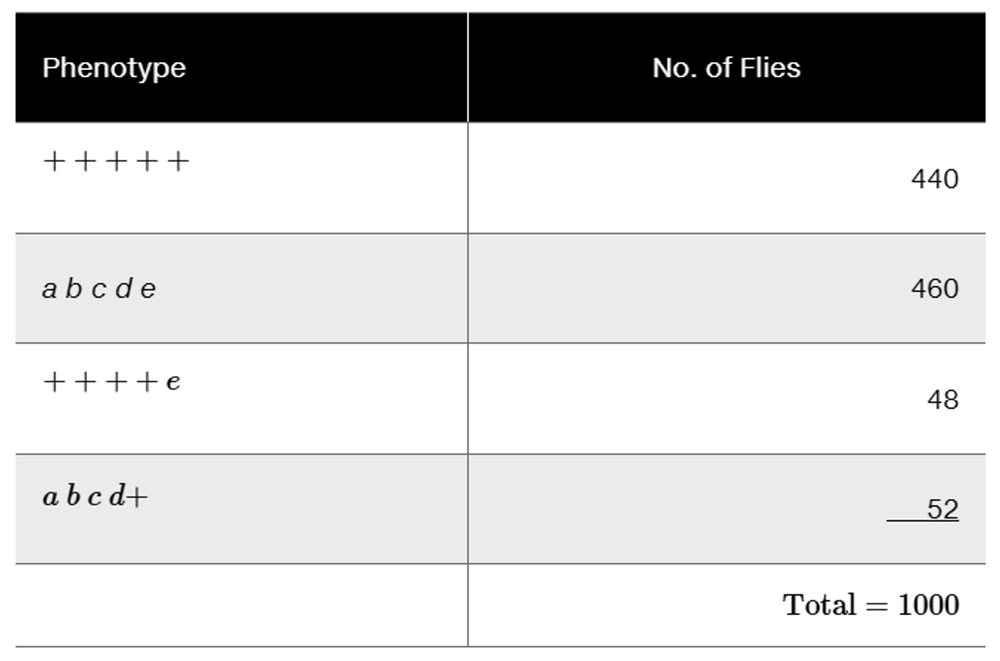
In a cross in Drosophila, a female heterozygous for the autosomally linked genes a, b, c, d, and e (abcde/ +++++) was testcrossed with a male homozygous for all recessive alleles. Even though the distance between each of the loci was at least 3 map units, only four phenotypes were recovered, yielding the following data:
Why are many expected crossover phenotypes missing? Can any of these loci be mapped from the data given here? If so, determine map distances.