Ch. 8 - Genetic Analysis and Mapping in Bacteria and Bacteriophages
Klug - Essentials of Genetics 10th Edition
Klug10th EditionEssentials of GeneticsISBN: 9780135588789Non è quello che usi tu?Cambia libro di testo
Capitolo 8, Problema 14

A plaque assay is performed beginning with 1 mL of a solution containing bacteriophages. This solution is serially diluted three times by combining 0.1 mL of each sequential dilution with 9.9 mL of liquid medium. Then 0.1 mL of the final dilution is plated in the plaque assay and yields 17 plaques. What is the initial density of bacteriophages in the original 1 mL?

Guida verificata passo dopo passo
1
Understand the dilution process: Each dilution step involves taking 0.1 mL of the previous solution and adding it to 9.9 mL of liquid medium. This creates a dilution factor of \(\frac{0.1}{0.1 + 9.9} = \frac{0.1}{10} = 0.01\) for each step.
Calculate the total dilution factor after three serial dilutions by multiplying the dilution factors of each step: \(0.01 \times 0.01 \times 0.01 = (0.01)^3\).
Determine the dilution factor for the plated volume: Since 0.1 mL of the final dilution is plated, the number of plaques corresponds to the number of phages in that 0.1 mL volume of the diluted solution.
Use the plaque count to find the concentration of phages in the final diluted solution by dividing the number of plaques by the plated volume: \(\text{phage concentration in final dilution} = \frac{17}{0.1 \text{ mL}}\).
Calculate the initial phage concentration in the original 1 mL by dividing the concentration in the final dilution by the total dilution factor: \(\text{initial concentration} = \frac{\text{phage concentration in final dilution}}{(0.01)^3}\).

Risposta video verificata per un problema simile:

Questa soluzione video è stata consigliata dai nostri tutor come utile per risolvere questo problema.
Durata del video:
40s

Concetti chiave

Ecco i concetti essenziali che devi comprendere per rispondere correttamente alla domanda.

Serial Dilution

Serial dilution is a stepwise dilution of a substance in solution, where a fixed volume is transferred and diluted repeatedly. Each dilution reduces the concentration by a known factor, allowing for easier quantification of particles like bacteriophages in a sample.

Plaque Assay

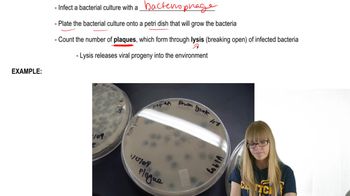
A plaque assay is a method used to quantify the number of infectious virus particles (bacteriophages) in a sample. Each plaque represents an area where a single phage infected and lysed bacterial cells, so counting plaques helps estimate the phage concentration.
Video consigliato:
Percorso guidato
03:44
Plaques and Experiments

Calculating Initial Concentration from Dilutions

To find the original concentration, multiply the number of plaques by the inverse of the dilution factor and the plated volume factor. This calculation accounts for the dilution steps and the volume plated, converting plaque counts back to the initial phage density.
Video consigliato:
Percorso guidato
07:01
Lac Operon Summary