Ch. 8 - Genetic Analysis and Mapping in Bacteria and Bacteriophages
Klug - Essentials of Genetics 10th Edition
Klug10th EditionEssentials of GeneticsISBN: 9780135588789Non è quello che usi tu?Cambia libro di testo
Capitolo 8, Problema 13

In the plaque assay, exactly what makes up a single plaque?

Guida verificata passo dopo passo
1
Understand that a plaque assay is a method used to quantify the number of virus particles capable of infecting cells in a sample.
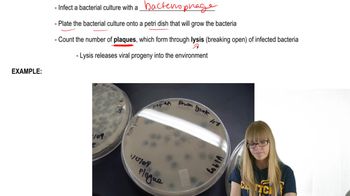
Recognize that a single plaque represents a clear zone on a layer of host cells where the virus has infected and lysed the cells.
Know that each plaque originates from a single infectious virus particle, also called a plaque-forming unit (PFU).
Realize that the virus infects a host cell, replicates, and spreads to neighboring cells, causing cell death and forming the visible plaque.
Therefore, a single plaque is made up of a localized area of lysed host cells resulting from infection by one infectious virus particle.

Concetti chiave

Ecco i concetti essenziali che devi comprendere per rispondere correttamente alla domanda.

Plaque Assay

A plaque assay is a laboratory method used to quantify the number of infectious virus particles in a sample by infecting a layer of host cells. Each infectious virus particle infects a cell and spreads to neighboring cells, creating a clear zone called a plaque where cells have been destroyed.
Video consigliato:
Percorso guidato
03:44
Plaques and Experiments

Plaque Formation

A single plaque forms when one infectious virus particle infects a host cell and replicates, causing cell lysis. The infection spreads locally to adjacent cells, resulting in a visible clear area or plaque, which represents the progeny of that original virus particle.
Video consigliato:
Percorso guidato
03:44
Plaques and Experiments

Relationship Between Plaques and Virus Particles

Each plaque corresponds to one infectious virus particle, also called a plaque-forming unit (PFU). Counting plaques allows estimation of the concentration of infectious viruses in the original sample, assuming each plaque arises from a single virus.
Video consigliato:
Percorso guidato
03:44
Plaques and Experiments