Ch. 8 - Genetic Analysis and Mapping in Bacteria and Bacteriophages
Klug - Essentials of Genetics 10th Edition
Klug10th EditionEssentials of GeneticsISBN: 9780135588789Non è quello che usi tu?Cambia libro di testo
Capitolo 8, Problema 18

Describe the execution of and rationale behind linkage and mapping studies of bacterial genes during transduction experiments.

Guida verificata passo dopo passo
1
Begin by understanding that linkage and mapping studies in bacteria during transduction aim to determine the relative positions of genes on the bacterial chromosome based on how frequently they are co-transduced together.
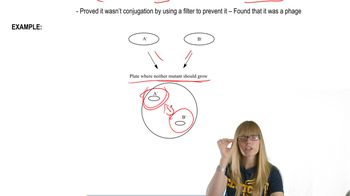
Recognize that transduction involves the transfer of bacterial DNA from a donor to a recipient bacterium via a bacteriophage, which packages fragments of the donor's DNA during infection.
During the experiment, infect donor bacteria with a phage, allow the phage to package bacterial DNA, then use these phage particles to infect recipient bacteria, selecting for specific genetic markers to identify which genes have been transferred.
Measure the frequency of co-transduction of two or more genes by calculating the proportion of recipient bacteria that receive both genes simultaneously; genes that are physically closer on the chromosome have a higher chance of being co-transduced.
Use the co-transduction frequencies to estimate the distance between genes on the chromosome, applying the formula \(\text{Distance} = 1 - \frac{\text{Co-transduction frequency}}{\text{Maximum co-transduction frequency}}\), which helps construct a genetic map showing gene order and relative distances.

Concetti chiave

Ecco i concetti essenziali che devi comprendere per rispondere correttamente alla domanda.

Bacterial Transduction

Transduction is a process where bacteriophages transfer genetic material between bacteria. During this, phages accidentally package host DNA and inject it into a new bacterial cell, enabling gene transfer without direct contact. Understanding transduction is essential for studying gene linkage and mapping in bacteria.
Video consigliato:

Gene Linkage in Bacteria

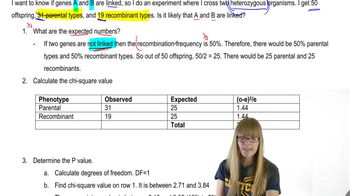
Gene linkage refers to the tendency of genes located close together on the same DNA molecule to be inherited together. In bacteria, linked genes are more likely to be co-transduced by a phage, which helps determine their relative positions on the chromosome based on co-transduction frequencies.
Video consigliato:
Percorso guidato
07:33
Chi Square and Linkage

Genetic Mapping via Co-transduction Frequency

Mapping bacterial genes involves measuring how often two genes are transferred together during transduction. Higher co-transduction frequency indicates closer proximity on the chromosome. This method allows researchers to construct genetic maps by estimating distances between genes based on their co-transduction rates.
Video consigliato: