Ch. 8 - Genetic Analysis and Mapping in Bacteria and Bacteriophages
Klug - Essentials of Genetics 10th Edition
Klug10th EditionEssentials of GeneticsISBN: 9780135588789Non è quello che usi tu?Cambia libro di testo
Capitolo 8, Problema 19

If a single bacteriophage infects one E. coli cell present on a lawn of bacteria and, upon lysis, yields 200 viable viruses, how many phages will exist in a single plaque if three more lytic cycles occur?

Guida verificata passo dopo passo
1
Understand the problem: A single bacteriophage infects one E. coli cell and produces 200 new phages after one lytic cycle. We want to find the total number of phages after three additional lytic cycles, starting from this initial burst.
Identify the multiplication factor per lytic cycle: Each infected cell produces 200 phages, so each cycle multiplies the phage number by 200.
Express the total number of phages after multiple cycles using exponential growth: If \(N_0\) is the initial number of phages, and \(k\) is the number of cycles, then the total number of phages \(N\) after \(k\) cycles is given by the formula: \(N = N_0 \times 200^k\)
Apply the formula to the problem: Here, the initial number of phages after the first lytic cycle is 200 (since one phage produced 200), and we want to find the number after three more cycles, so \(k=3\). Substitute these values into the formula.
Interpret the result: The final number represents the total number of phages in a single plaque after the initial infection and three additional lytic cycles.

Risposta video verificata per un problema simile:

Questa soluzione video è stata consigliata dai nostri tutor come utile per risolvere questo problema.
Durata del video:
1m

Concetti chiave

Ecco i concetti essenziali che devi comprendere per rispondere correttamente alla domanda.

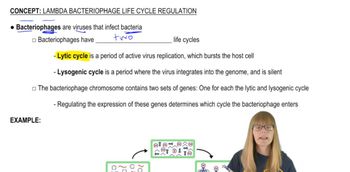
Bacteriophage Life Cycle

Bacteriophages infect bacterial cells and replicate inside them, eventually causing cell lysis to release new viral particles. The lytic cycle involves infection, replication, assembly, and lysis, producing multiple progeny phages from a single infected cell.
Video consigliato:
Percorso guidato
04:29
Bacteriophage Life Cycle

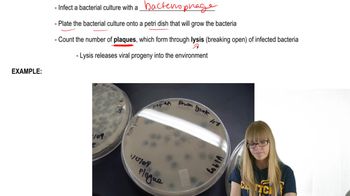
Plaque Formation on Bacterial Lawn

A plaque is a clear zone on a bacterial lawn where phages have lysed bacterial cells. Each plaque originates from a single phage infection and expands as successive lytic cycles infect neighboring cells, increasing the number of phages exponentially.
Video consigliato:
Percorso guidato
03:44
Plaques and Experiments

Exponential Growth in Lytic Cycles

During each lytic cycle, the number of phages multiplies by the burst size (number of phages produced per infected cell). After multiple cycles, the total phage count equals the initial burst size raised to the power of the number of cycles, demonstrating exponential growth.
Video consigliato:
Percorso guidato
08:04
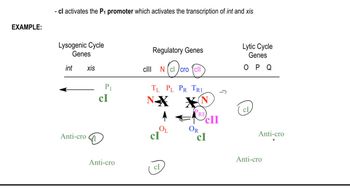
Decision Between Lytic and Lysogenic Cycles