Ch. 8 - Genetic Analysis and Mapping in Bacteria and Bacteriophages
Klug - Essentials of Genetics 10th Edition
Klug10th EditionEssentials of GeneticsISBN: 9780135588789Non è quello che usi tu?Cambia libro di testo
Capitolo 8, Problema 4b

With respect to F⁺ and F⁻ bacterial matings, answer the following questions: How was it established that chromosome transfer was unidirectional?

Guida verificata passo dopo passo
1
Understand the biological context: In bacterial conjugation between F⁺ (donor) and F⁻ (recipient) cells, genetic material is transferred from one cell to another. The question focuses on how it was shown that this transfer occurs in one direction only—from the F⁺ donor to the F⁻ recipient.
Review the experimental design: Scientists mixed F⁺ and F⁻ bacteria and then separated the two populations after conjugation. They used genetic markers unique to each strain to track the movement of DNA.
Analyze the results: By checking which markers appeared in the recipient cells after mating, researchers observed that only donor markers were transferred to the recipient, and no recipient markers were found in the donor cells.
Interpret the findings: The absence of recipient markers in donor cells indicated that DNA transfer did not occur from F⁻ to F⁺ cells, establishing the unidirectional nature of chromosome transfer during conjugation.
Summarize the conclusion: The unidirectionality was confirmed by the selective presence of donor genetic material in recipients and the lack of reciprocal transfer, demonstrating that chromosome transfer proceeds only from F⁺ to F⁻ cells.

Risposta video verificata per un problema simile:

Questa soluzione video è stata consigliata dai nostri tutor come utile per risolvere questo problema.
Durata del video:
2m

Concetti chiave

Ecco i concetti essenziali che devi comprendere per rispondere correttamente alla domanda.

F⁺ and F⁻ Bacterial Mating

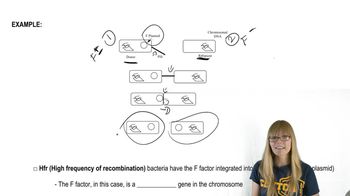
F⁺ bacteria contain the fertility factor (F plasmid) and can initiate conjugation by forming a pilus to connect with F⁻ bacteria, which lack the F plasmid. This mating allows genetic material transfer from F⁺ to F⁻ cells, enabling the study of gene transfer mechanisms.
Video consigliato:
Percorso guidato
08:52
F Factor and Hfr

Unidirectional Chromosome Transfer

In bacterial conjugation, DNA transfer occurs only from the F⁺ donor to the F⁻ recipient, not in reverse. This unidirectionality was demonstrated by tracking genetic markers and observing that only the recipient acquired donor genes, confirming the direction of transfer.
Video consigliato:
Percorso guidato
07:10
Chromosome Structure

Use of Genetic Markers to Trace DNA Transfer

Researchers used specific genetic markers on donor and recipient chromosomes to monitor gene movement during conjugation. By analyzing which markers appeared in the recipient after mating, they established the direction and extent of chromosome transfer.
Video consigliato:
Percorso guidato
07:11
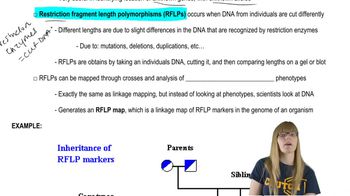
Mapping with Markers