Ch. 8 - Genetic Analysis and Mapping in Bacteria and Bacteriophages
Klug - Essentials of Genetics 10th Edition
Klug10th EditionEssentials of GeneticsISBN: 9780135588789Non è quello che usi tu?Cambia libro di testo
Capitolo 8, Problema 4a

With respect to F⁺ and F⁻ bacterial matings, answer the following questions: How was it established that physical contact between cells was necessary?

Guida verificata passo dopo passo
1
Understand the biological context: F⁺ bacteria contain the F plasmid and can donate genetic material to F⁻ bacteria, which lack the plasmid, through a process called conjugation.
Recognize that the question asks about the experimental evidence showing that physical contact between F⁺ and F⁻ cells is necessary for conjugation to occur.
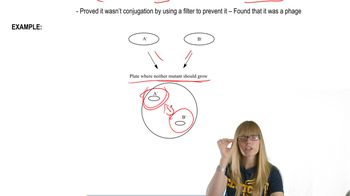
Recall the classic experiment where researchers used a U-tube apparatus with a filter that allowed the passage of liquid and small molecules but prevented direct cell-to-cell contact between F⁺ and F⁻ bacteria.
Note that when F⁺ and F⁻ cells were separated by this filter, no genetic transfer occurred, indicating that soluble factors alone were insufficient for conjugation.
Conclude that the necessity of physical contact was established because genetic transfer only happened when F⁺ and F⁻ cells were allowed to touch directly, demonstrating that conjugation requires cell-to-cell contact.

Risposta video verificata per un problema simile:

Questa soluzione video è stata consigliata dai nostri tutor come utile per risolvere questo problema.
Durata del video:
1m

Concetti chiave

Ecco i concetti essenziali che devi comprendere per rispondere correttamente alla domanda.

F⁺ and F⁻ Bacterial Mating

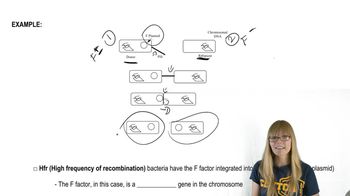
F⁺ bacteria contain the fertility (F) plasmid, enabling them to form a pilus and transfer genetic material to F⁻ bacteria, which lack the plasmid. This conjugation process results in the transfer of the F plasmid, converting F⁻ cells into F⁺ cells.
Video consigliato:
Percorso guidato
08:52
F Factor and Hfr

Role of Physical Contact in Conjugation

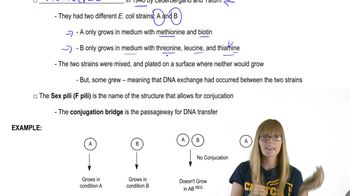
Physical contact between F⁺ and F⁻ cells is essential for conjugation because the F pilus connects the two cells, allowing DNA transfer. Experiments using filters that prevent cell contact but allow molecular diffusion showed no gene transfer, proving contact is necessary.
Video consigliato:
Percorso guidato
04:06
Conjugation Overview

Experimental Evidence Using Membrane Filters

Researchers used membrane filters with pores small enough to block bacteria but allow molecules to pass. When F⁺ and F⁻ cells were separated by such filters, no conjugation occurred, demonstrating that direct cell-to-cell contact, not just chemical signals, is required for DNA transfer.
Video consigliato: