Ch. 26 - Population and Evolutionary Genetics
Klug - Concepts of Genetics 12th Edition
Klug12th EditionConcepts of GeneticsISBN: 9780135564776Non è quello che usi tu?Cambia libro di testo
Capitolo 26, Problema 6b

Consider rare disorders in a population caused by an autosomal recessive mutation. From the frequencies of the disorder in the population given, calculate the percentage of heterozygous carriers:
0.000081

Guida verificata passo dopo passo
1
Identify the given value as the frequency of individuals affected by the autosomal recessive disorder, which corresponds to the homozygous recessive genotype frequency \(q^2 = 0.000081\).
Calculate the allele frequency of the recessive allele \(q\) by taking the square root of the affected frequency: \(q = \sqrt{q^2}\).
Determine the frequency of the dominant allele \(p\) using the relationship \(p + q = 1\), so \(p = 1 - q\).
Calculate the frequency of heterozygous carriers (the carriers) using the Hardy-Weinberg formula for heterozygotes: \$2pq$.
Convert the heterozygous carrier frequency \$2pq$ into a percentage by multiplying by 100 to express the final answer as a percentage of the population.

Risposta video verificata per un problema simile:

Questa soluzione video è stata consigliata dai nostri tutor come utile per risolvere questo problema.
Durata del video:
1m

Concetti chiave

Ecco i concetti essenziali che devi comprendere per rispondere correttamente alla domanda.

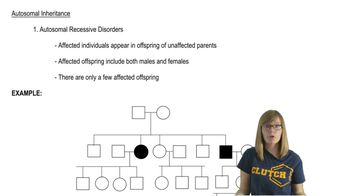
Autosomal Recessive Inheritance

Autosomal recessive disorders require two copies of a mutated gene for the phenotype to appear. Individuals with only one mutated allele are carriers and typically do not show symptoms. Understanding this inheritance pattern is essential to relate genotype frequencies to disease prevalence.
Video consigliato:
Percorso guidato
09:08
Autosomal Pedigrees

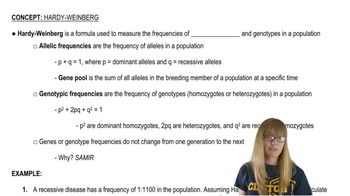
Hardy-Weinberg Equilibrium

The Hardy-Weinberg principle provides a mathematical framework to relate allele and genotype frequencies in a population under random mating and no evolutionary forces. It allows calculation of carrier frequencies from disease prevalence using p² + 2pq + q² = 1, where q² represents affected individuals.
Video consigliato:

Calculating Carrier Frequency from Disease Prevalence

For an autosomal recessive disorder, the disease frequency equals q² (homozygous recessive). The carrier frequency is 2pq, where p ≈ 1 for rare alleles. By taking the square root of disease frequency to find q, one can estimate the percentage of heterozygous carriers in the population.
Video consigliato:
Percorso guidato
03:03
New Alleles and Migration
Pratica correlata
Domanda del libro di testo

Consider rare disorders in a population caused by an autosomal recessive mutation. From the frequencies of the disorder in the population given, calculate the percentage of heterozygous carriers:

0.01

543
views
Domanda del libro di testo

The use of nucleotide sequence data to measure genetic variability is complicated by the fact that the genes of many eukaryotes are complex in organization and contain 5' and 3' flanking regions as well as introns. Researchers have compared the nucleotide sequence of two cloned alleles of the γ-globin gene from a single individual and found a variation of 1 percent. Those differences include 13 substitutions of one nucleotide for another and three short DNA segments that have been inserted in one allele or deleted in the other. None of the changes takes place in the gene's exons (coding regions). Why do you think this is so, and should it change our concept of genetic variation?

474
views
Domanda del libro di testo

Consider rare disorders in a population caused by an autosomal recessive mutation. From the frequencies of the disorder in the population given, calculate the percentage of heterozygous carriers:

0.10

411
views
Domanda del libro di testo

The genetic difference between two Drosophila species, D. heteroneura and D. silvestris, as measured by nucleotide diversity, is about 1.8 percent. The difference between chimpanzees (Pan troglodytes) and humans (H. sapiens) is about the same, yet the latter species is classified in a different genera. In your opinion, is this valid? Explain why.

583
views
Domanda del libro di testo

Consider rare disorders in a population caused by an autosomal recessive mutation. From the frequencies of the disorder in the population given, calculate the percentage of heterozygous carriers:

0.09

466
views
Domanda del libro di testo

Consider rare disorders in a population caused by an autosomal recessive mutation. From the frequencies of the disorder in the population given, calculate the percentage of heterozygous carriers:

0.0064

464
views