Ch. 6 - Genetic Analysis and Mapping in Bacteria and Bacteriophages
Klug - Concepts of Genetics 12th Edition
Klug12th EditionConcepts of GeneticsISBN: 9780135564776Non è quello che usi tu?Cambia libro di testo
Capitolo 6, Problema 21

During the analysis of seven rII mutations in phage T4, mutants 1, 2, and 6 were in cistron A, while mutants 3, 4, and 5 were in cistron B. Of these, mutant 4 was a deletion overlapping mutant 5. The remainder were point mutations. Nothing was known about mutant 7. Predict the results of complementation (+ or -) between 1 and 2; 1 and 3; 2 and 4; and 4 and 5.

Guida verificata passo dopo passo
1
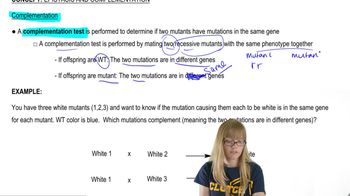
Understand the concept of complementation: Complementation occurs when two mutations in different cistrons (functional units of a gene) allow the organism to produce a functional product. If the mutations are in the same cistron, complementation does not occur (-). If they are in different cistrons, complementation occurs (+).
Identify the cistrons for each mutant: Mutants 1, 2, and 6 are in cistron A, while mutants 3, 4, and 5 are in cistron B. Mutant 7's cistron is unknown. Mutant 4 is a deletion overlapping mutant 5, while the others are point mutations.
Analyze the complementation between mutants 1 and 2: Since both mutants 1 and 2 are in cistron A, they cannot complement each other. The result will be (-).
Analyze the complementation between mutants 1 and 3: Mutant 1 is in cistron A, and mutant 3 is in cistron B. Since they are in different cistrons, they can complement each other. The result will be (+).
Analyze the complementation between mutants 2 and 4, and between mutants 4 and 5: Mutant 2 is in cistron A, and mutant 4 is in cistron B, so they can complement each other (+). However, mutant 4 is a deletion overlapping mutant 5, so they cannot complement each other (-).

Risposta video verificata per un problema simile:

Questa soluzione video è stata consigliata dai nostri tutor come utile per risolvere questo problema.
Durata del video:
31s

Concetti chiave

Ecco i concetti essenziali che devi comprendere per rispondere correttamente alla domanda.

Cistron and Complementation

A cistron is a segment of DNA that encodes a single polypeptide and is synonymous with a gene. Complementation occurs when two different mutations in the same gene are present in a diploid organism, and the wild-type phenotype is restored. In the context of phage T4, if two mutations are in different cistrons, they will complement each other, resulting in a positive complementation test.
Video consigliato:
Percorso guidato
05:05
Complementation

Point Mutations vs. Deletions

Point mutations are changes in a single nucleotide base pair in the DNA sequence, which can lead to a change in a single amino acid in a protein. Deletions, on the other hand, involve the loss of a segment of DNA, which can disrupt the reading frame and potentially result in a nonfunctional protein. Understanding the nature of these mutations is crucial for predicting complementation outcomes.
Video consigliato:
Percorso guidato
09:49
Point Mutations

Mutant Analysis in Phage Genetics

In phage genetics, analyzing mutants helps to determine the functional relationships between genes. By studying how different mutations interact, researchers can infer whether they affect the same or different cistrons. This analysis is essential for predicting complementation results, as it reveals whether the mutations can compensate for each other’s effects on the phage's ability to infect host cells.
Video consigliato:
Percorso guidato
02:48
Chi Square Analysis
Pratica correlata
Domanda del libro di testo

Using mutants 2 and 3 from Problem 19, following mixed infection on E. coli B, progeny viruses were plated in a series of dilutions on both E. coli B and K12 with the following results.

Another mutation, 6, was tested in relation to mutations 1 through 5 from Problems 18–20. In initial testing, mutant 6 complemented mutants 2 and 3. In recombination testing with 1, 4, and 5, mutant 6 yielded recombinants with 1 and 5, but not with 4. What can you conclude about mutation 6?

539
views
Domanda del libro di testo

Using mutants 2 and 3 from Problem 19, following mixed infection on E. coli B, progeny viruses were plated in a series of dilutions on both E. coli B and K12 with the following results.

What is the recombination frequency between the two mutants?

622
views
Domanda del libro di testo

In studies of recombination between mutants 1 and 2 from Problem 21, the results shown in the following table were obtained.

Calculate the recombination frequency.

494
views
Domanda del libro di testo

In studies of recombination between mutants 1 and 2 from Problem 21, the results shown in the following table were obtained.

When mutant 6 was tested for recombination with mutant 1, the data were the same as those shown above for strain B, but not for K12. The researcher lost the K12 data but remembered that recombination was ten times more frequent than when mutants 1 and 2 were tested. What were the lost values (dilution and plaque numbers)?

512
views
Domanda del libro di testo
In studies of recombination between mutants 1 and 2 from Problem 21, the results shown in the following table were obtained. Strain Dilution Plaques Phenotypes E. coli B 10⁻⁷ 4 r E. coli K12 10⁻² 8 + Mutant 7 (Problem 21) failed to complement any of the other mutants (1–6). Define the nature of mutant 7.
507
views
Domanda del libro di testo

If further testing of the mutations in Problem 18 yielded the following results, what would you conclude about mutant 5?

503
views