Ch. 6 - Genetic Analysis and Mapping in Bacteria and Bacteriophages
Klug - Concepts of Genetics 12th Edition
Klug12th EditionConcepts of GeneticsISBN: 9780135564776Non è quello che usi tu?Cambia libro di testo
Capitolo 6, Problema 19

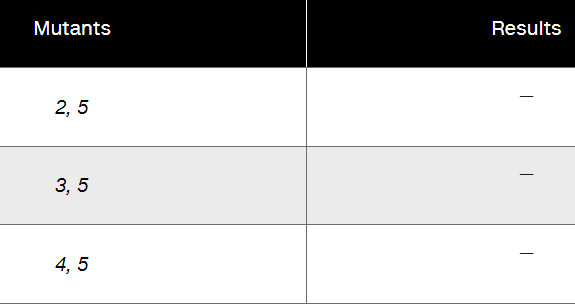
If further testing of the mutations in Problem 18 yielded the following results, what would you conclude about mutant 5?
Table showing mutants pairs 2 and 5, 3 and 5, 4 and 5 with no results indicated for each pair.

Guida verificata passo dopo passo
1
Analyze the data provided in the table. The '-' symbol indicates that the combination of the two mutants does not restore the wild-type phenotype, meaning the mutations are in the same gene or pathway.
Understand the concept of complementation testing. Complementation occurs when two mutations in different genes restore the wild-type phenotype when combined. If no complementation occurs (indicated by '-'), the mutations are likely in the same gene.
Focus on mutant 5. Since mutant 5 does not complement mutants 2, 3, or 4 (all combinations with mutant 5 yield '-'), this suggests that mutant 5 is in the same gene as mutants 2, 3, and 4.
Conclude that mutant 5 is part of the same complementation group as mutants 2, 3, and 4. A complementation group represents a set of mutations that affect the same gene.
Summarize your findings: Mutant 5 does not complement mutants 2, 3, or 4, indicating that all these mutants are likely in the same gene and belong to the same complementation group.

Risposta video verificata per un problema simile:

Questa soluzione video è stata consigliata dai nostri tutor come utile per risolvere questo problema.
Durata del video:
2m

Concetti chiave

Ecco i concetti essenziali che devi comprendere per rispondere correttamente alla domanda.

Mutation Analysis

Mutation analysis involves studying changes in the DNA sequence that can affect an organism's phenotype. By examining the results of various mutations, researchers can determine the functional impact of specific genetic alterations. In this context, understanding how different mutations interact with each other is crucial for interpreting the results related to mutant 5.
Video consigliato:
Percorso guidato
02:48
Chi Square Analysis

Genetic Interactions

Genetic interactions refer to the ways in which different genes influence each other's expression and function. This can include epistasis, where one gene's effect masks or modifies another's. The results from the mutants suggest that the interactions between mutant 5 and the other mutants (2, 3, and 4) are essential for drawing conclusions about the nature of mutant 5's phenotype.
Video consigliato:
Percorso guidato
07:56
Interacting Genes Overview

Phenotypic Outcomes

Phenotypic outcomes are the observable traits or characteristics of an organism resulting from the interaction of its genotype with the environment. In the context of the question, the results of the mutations provide insight into how mutant 5 behaves in relation to other mutants, which can help infer its role in the genetic pathway being studied.
Video consigliato:
Percorso guidato
10:48
Mutations and Phenotypes
Pratica correlata
Domanda del libro di testo

Using mutants 2 and 3 from Problem 19, following mixed infection on E. coli B, progeny viruses were plated in a series of dilutions on both E. coli B and K12 with the following results.

Another mutation, 6, was tested in relation to mutations 1 through 5 from Problems 18–20. In initial testing, mutant 6 complemented mutants 2 and 3. In recombination testing with 1, 4, and 5, mutant 6 yielded recombinants with 1 and 5, but not with 4. What can you conclude about mutation 6?

539
views
Domanda del libro di testo

Using mutants 2 and 3 from Problem 19, following mixed infection on E. coli B, progeny viruses were plated in a series of dilutions on both E. coli B and K12 with the following results.

What is the recombination frequency between the two mutants?

622
views
Domanda del libro di testo

During the analysis of seven rII mutations in phage T4, mutants 1, 2, and 6 were in cistron A, while mutants 3, 4, and 5 were in cistron B. Of these, mutant 4 was a deletion overlapping mutant 5. The remainder were point mutations. Nothing was known about mutant 7. Predict the results of complementation (+ or -) between 1 and 2; 1 and 3; 2 and 4; and 4 and 5.

614
views
Domanda del libro di testo

In an analysis of rII mutants, complementation testing yielded the following results:

1090
views
Domanda del libro di testo

If a single bacteriophage infects one E. coli cell present on a lawn of bacteria and, upon lysis, yields 200 viable viruses, how many phages will exist in a single plaque if three more lytic cycles occur?

650
views
Domanda del libro di testo

In recombination studies of the rII locus in phage T4, what is the significance of the value determined by calculating phage growth in the K12 versus the B strains of E. coli following simultaneous infection in E. coli B? Which value is always greater?

890
views