Ch. 1 - The Molecular Basis of Heredity, Variation, and Evolution
Sanders - Genetic Analysis: An Integrated Approach 3rd Edition
Sanders3rd EditionGenetic Analysis: An Integrated ApproachISBN: 9780135564172Non è quello che usi tu?Cambia libro di testo
Capitolo 1, Problema 10c

Define each of the following terms:
Central dogma of biology

Guida verificata passo dopo passo
1
The central dogma of biology is a fundamental concept that describes the flow of genetic information within a biological system.
It explains how genetic information is transferred from DNA to RNA and then to proteins, which are the functional molecules in cells.
The process begins with transcription, where the DNA sequence of a gene is copied into messenger RNA (mRNA).
The mRNA then undergoes translation, where the sequence of nucleotides in the mRNA is read in sets of three (codons) to assemble a specific sequence of amino acids, forming a protein.
This concept is often summarized as DNA → RNA → Protein, highlighting the directional flow of genetic information.

Risposta video verificata per un problema simile:

Questa soluzione video è stata consigliata dai nostri tutor come utile per risolvere questo problema.
Durata del video:
2m

Concetti chiave

Ecco i concetti essenziali che devi comprendere per rispondere correttamente alla domanda.

Central Dogma of Molecular Biology

The Central Dogma of Molecular Biology describes the flow of genetic information within a biological system. It outlines the process by which DNA is transcribed into RNA, which is then translated into proteins. This framework is fundamental for understanding how genes dictate cellular functions and the synthesis of proteins, which are crucial for the structure and function of living organisms.
Video consigliato:
Percorso guidato
07:11
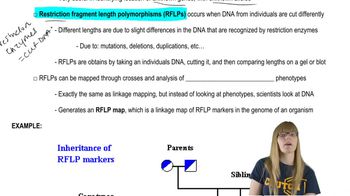
Mapping with Markers

DNA Transcription

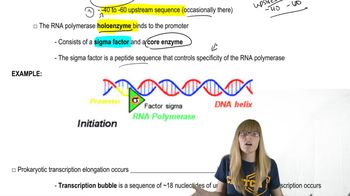
DNA transcription is the first step in the Central Dogma, where a specific segment of DNA is copied into messenger RNA (mRNA) by the enzyme RNA polymerase. This process involves unwinding the DNA double helix and synthesizing a complementary RNA strand based on the DNA template. Transcription is essential for gene expression, allowing the genetic code to be converted into a format that can be translated into proteins.
Video consigliato:
Percorso guidato
10:14
Prokaryotic Transcription

Translation

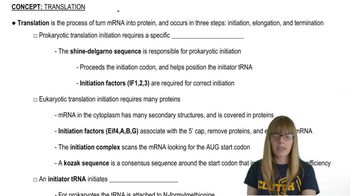
Translation is the second step in the Central Dogma, where the mRNA produced during transcription is decoded by ribosomes to synthesize proteins. During this process, transfer RNA (tRNA) molecules bring amino acids to the ribosome, matching their anticodons with the codons on the mRNA strand. This step is critical for producing the proteins that perform various functions in the cell, ultimately determining the organism's traits.
Video consigliato:
Percorso guidato
07:58
Translation initiation