Indietro
Problema 1a
Draw a diagram illustrating the alleles on homologous chromosomes for the genotypes given, assuming in each case that the genes reside on the chromosome in the order written.
AB/ab
Problema 1b
Draw a diagram illustrating the alleles on homologous chromosomes for the genotypes given, assuming in each case that the genes reside on the chromosome in the order written.
aBc/abC
Problema 1c
Draw a diagram illustrating the alleles on homologous chromosomes for the genotypes given, assuming in each case that the genes reside on the chromosome in the order written.
DFg/DFG
Problema 1d
Give the information requested.
The gametes produced by an organism with the genotype Rt/rT
Problema 1e
Give the information requested.
Progeny of the cross Rt/rT×rt/rt
Problema 2a
In a diploid species of plant, the genes for plant height and fruit shape are syntenic and separated by 18 m.u. Allele D produces tall plants and is dominant to d for short plants, and allele R produces round fruit and is dominant to r for oval fruit.
A plant with the genotype DR/dr produces gametes. Identify gamete genotypes, label parental and recombinant gametes, and give the frequency of each gamete genotype.
Problema 2b
In a diploid species of plant, the genes for plant height and fruit shape are syntenic and separated by 18 m.u. Allele D produces tall plants and is dominant to d for short plants, and allele R produces round fruit and is dominant to r for oval fruit.
Give the same information for a plant with the genotype Dr/dR.
Problema 3a
A pure-breeding tall plant producing oval fruit as described in Problem 2 is crossed to a pure-breeding short plant producing round fruit.
The F₁ are crossed to short plants producing oval fruit. What are the expected proportions of progeny phenotypes?
Problema 3b
A pure-breeding tall plant producing oval fruit as described in Problem 2 is crossed to a pure-breeding short plant producing round fruit.
If the F₁ identified in part (a) are crossed to one another, what proportion of the F₂ are expected to be short and produce round fruit? What proportion are expected to be tall and produce round fruit?
Problema 4
Genes E and H are syntenic in an experimental organism with the genotype EH/eh. Assume that during each meiosis, one crossover occurs between these genes. No homologous chromosomes escape crossover, and none undergo double crossover. Are genes E and H genetically linked? Why or why not? What is the proportion of parental gametes produced by meiosis?
Problema 5a
In tomato plants, purple leaf color is controlled by a dominant allele A, and green leaf by a recessive allele a. At another locus, hairy leaf H is dominant to hairless leaf h. The genes for leaf color and leaf texture are separated by 16 m.u. on chromosome 5. On chromosome 4, a gene controlling leaf shape has two alleles: a dominant allele C that produces cut-leaf shape and a recessive allele c that produces potato-shaped leaves.
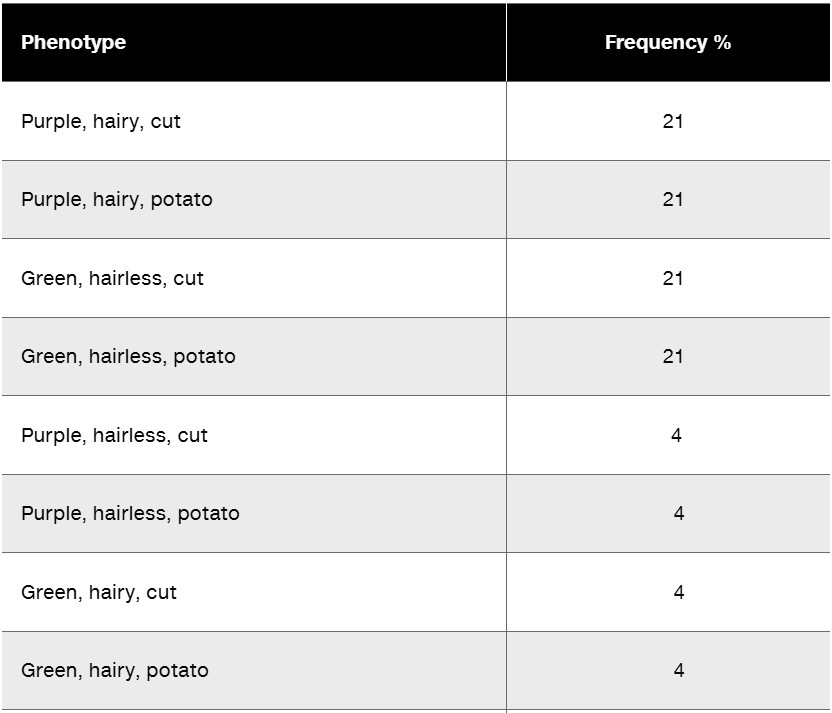
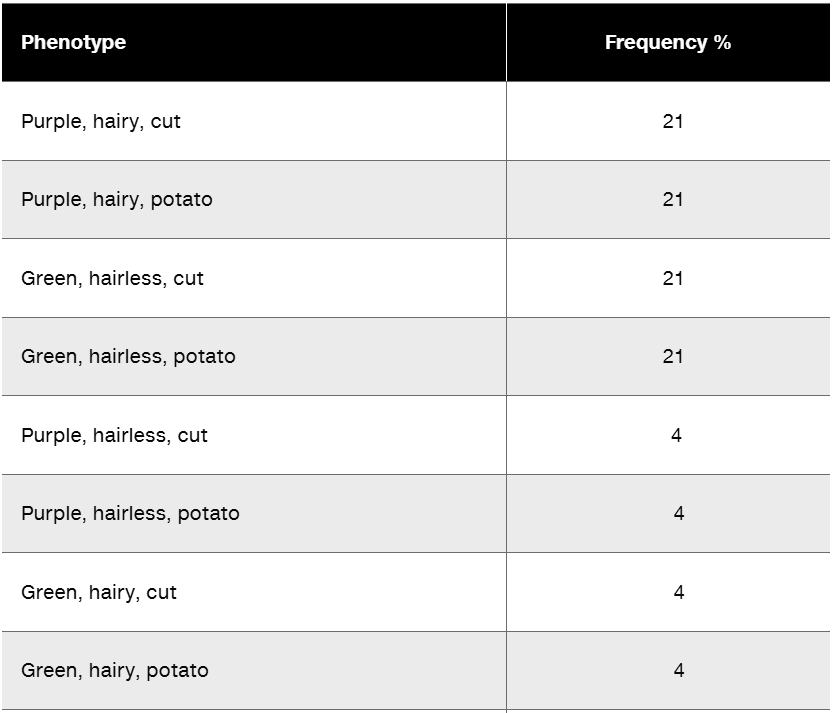
The cross of a purple, hairy, cut plant heterozygous at each gene to a green, hairless potato plant produces the following progeny:
Give the genotypes of parental and progeny plants in this experiment.
Problema 5b
In tomato plants, purple leaf color is controlled by a dominant allele A, and green leaf by a recessive allele a. At another locus, hairy leaf H is dominant to hairless leaf h. The genes for leaf color and leaf texture are separated by 16 m.u. on chromosome 5. On chromosome 4, a gene controlling leaf shape has two alleles: a dominant allele C that produces cut-leaf shape and a recessive allele c that produces potato-shaped leaves.
Fully explain the number and frequency of each phenotype class.
Problema 6a
In Drosophila, the map positions of genes are given in map units numbering from one end of a chromosome to the other. The X chromosome of Drosophila is 66 m.u. long. The X-linked gene for body color—with two alleles, y⁺ for gray body and y for yellow body—resides at one end of the chromosome at map position 0.0. A nearby locus for eye color, with alleles w⁺ for red eye and w for white eye, is located at map position 1.5. A third X-linked gene, controlling bristle form, with f⁺ for normal bristles and f for forked bristles, is located at map position 56.7. At each locus the wild-type allele is dominant over the mutant allele.
In a cross involving these three X-linked genes, do you expect any gene pair(s) to show genetic linkage? Explain your reasoning.
Problema 6b
In Drosophila, the map positions of genes are given in map units numbering from one end of a chromosome to the other. The X chromosome of Drosophila is 66 m.u. long. The X-linked gene for body color—with two alleles, y⁺ for gray body and y for yellow body—resides at one end of the chromosome at map position 0.0. A nearby locus for eye color, with alleles w⁺ for red eye and w for white eye, is located at map position 1.5. A third X-linked gene, controlling bristle form, with f⁺ for normal bristles and f for forked bristles, is located at map position 56.7. At each locus the wild-type allele is dominant over the mutant allele.
Do you expect any of these gene pair(s) to assort independently? Explain your reasoning.
Problema 6c
In Drosophila, the map positions of genes are given in map units numbering from one end of a chromosome to the other. The X chromosome of Drosophila is 66 m.u. long. The X-linked gene for body color—with two alleles, y⁺ for gray body and y for yellow body—resides at one end of the chromosome at map position 0.0. A nearby locus for eye color, with alleles w⁺ for red eye and w for white eye, is located at map position 1.5. A third X-linked gene, controlling bristle form, with f⁺ for normal bristles and f for forked bristles, is located at map position 56.7. At each locus the wild-type allele is dominant over the mutant allele.
A wild-type female fruit fly with the genotype y⁺w⁺f/ywf⁺ is crossed to a male fruit fly that has yellow body, white eye, and forked bristles. Predict the frequency of each progeny phenotype class produced by this mating.
Problema 6d
In Drosophila, the map positions of genes are given in map units numbering from one end of a chromosome to the other. The X chromosome of Drosophila is 66 m.u. long. The X-linked gene for body color—with two alleles, y⁺ for gray body and y for yellow body—resides at one end of the chromosome at map position 0.0. A nearby locus for eye color, with alleles w⁺ for red eye and w for white eye, is located at map position 1.5. A third X-linked gene, controlling bristle form, with f⁺ for normal bristles and f for forked bristles, is located at map position 56.7. At each locus the wild-type allele is dominant over the mutant allele.
Explain how each of the predicted progeny classes is produced.
Problema 7
Genes A, B, and C are linked on a chromosome and found in the order A–B–C. Genes A and B recombine with a frequency of 8%, and genes B and C recombine at a frequency of 24%. For the cross a⁺b⁺c/abc⁺ × abc/abc, predict the frequency of progeny genotypes. Assume interference is zero.
Problema 8a
Gene G recombines with gene T at a frequency of 7%, and gene G recombines with gene R at a frequency of 4%.
Draw two possible genetic maps for these three genes, and identify the recombination frequencies predicted for each map.
Problema 8b
Gene G recombines with gene T at a frequency of 7%, and gene G recombines with gene R at a frequency of 4%.
Assuming that organisms with any desired genotype are available, propose a genetic cross whose result could be used to determine which of the proposed genetic maps is correct.
Problema 9a
Genes A, B, C, D, and E are linked on a chromosome and occur in the order given.
The test cross Ae/aE x ae/ae indicates the genes recombine with a frequency of 28%. If 1000 progeny are produced by this test cross, determine the number of progeny in each outcome class.
Problema 9b
Genes A, B, C, D, and E are linked on a chromosome and occur in the order given.
Previous genetic linkage crosses have determined that recombination frequencies are 6% for genes A and B, 4% for genes B and C, 10% for genes C and D, and 11% for genes D and E. The sum of these frequencies between genes A and E is 31%. Why does the recombination distance between these genes as determined by adding the intervals between adjacent linked genes differ from the distance determined by the test cross?
Problema 10
Syntenic genes can assort independently. Explain this observation.
Problema 11
Define linkage disequilibrium. What is the physical basis of linkage, and what causes linkage equilibrium? Explain how crossing over eliminates linkage disequilibrium.
Problema 12a
On the Drosophila X chromosome, the dominant allele y⁺ produces gray body color and the recessive allele y produces yellow body. This gene is linked to one controlling full eye shape by a dominant allele lz⁺ and lozenge eye shape with a recessive allele lz. These genes recombine with a frequency of approximately 28%. The Lz gene is linked to gene F controlling bristle form, where the dominant phenotype is long bristles and the recessive one is forked bristles. The Lz and F genes recombine with a frequency of approximately 32%.
Using any genotypes you choose, design two separate crosses, one to test recombination between genes Y and Lz and the second between genes Lz and F. Assume 1000 progeny are produced by each cross, and give the number of progeny in each outcome category. (In setting up your crosses, remember that Drosophila males do not undergo recombination.)
Problema 12b
On the Drosophila X chromosome, the dominant allele y⁺ produces gray body color and the recessive allele y produces yellow body. This gene is linked to one controlling full eye shape by a dominant allele lz⁺ and lozenge eye shape with a recessive allele lz. These genes recombine with a frequency of approximately 28%. The Lz gene is linked to gene F controlling bristle form, where the dominant phenotype is long bristles and the recessive one is forked bristles. The Lz and F genes recombine with a frequency of approximately 32%.
Can any cross reveal genetic linkage between gene Y and gene F? Why or why not?
Problema 13a
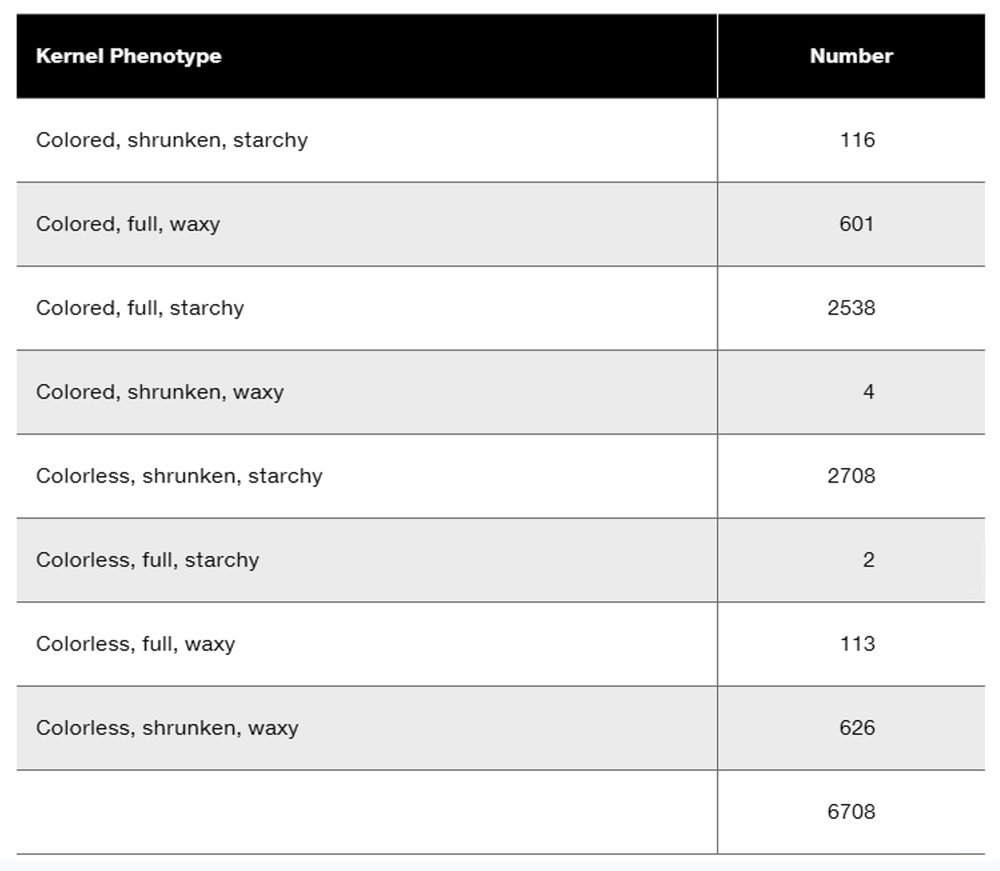
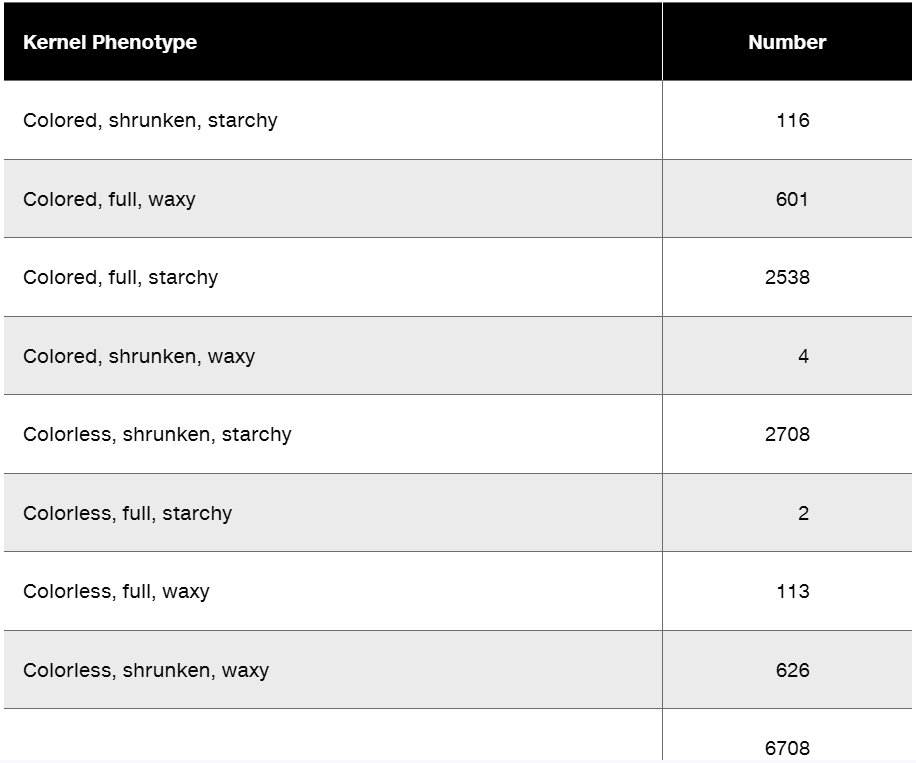
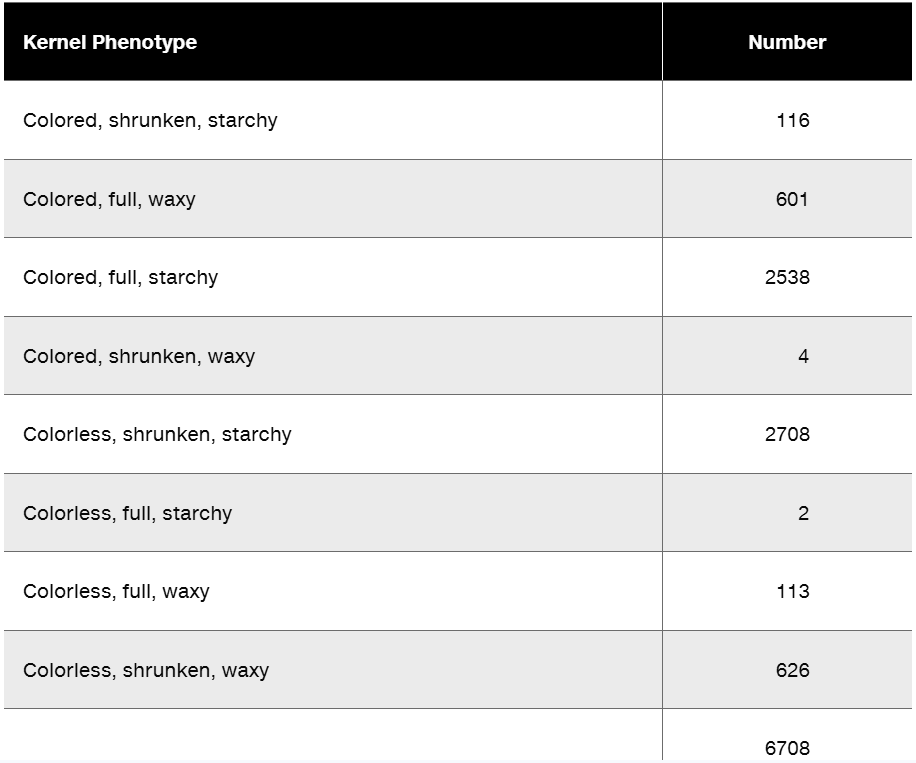
Researchers cross a corn plant that is pure-breeding for the dominant traits colored aleurone (C1), full kernel (Sh), and waxy endosperm (Wx) to a pure-breeding plant with the recessive traits colorless aleurone (c1), shrunken kernel (sh), and starchy (wx). The resulting F₁ plants were crossed to pure-breeding colorless, shrunken, starchy plants. Counting the kernels from about 30 ears of corn yields the following data.
Why are these data consistent with genetic linkage among the three genes?
Problema 13b
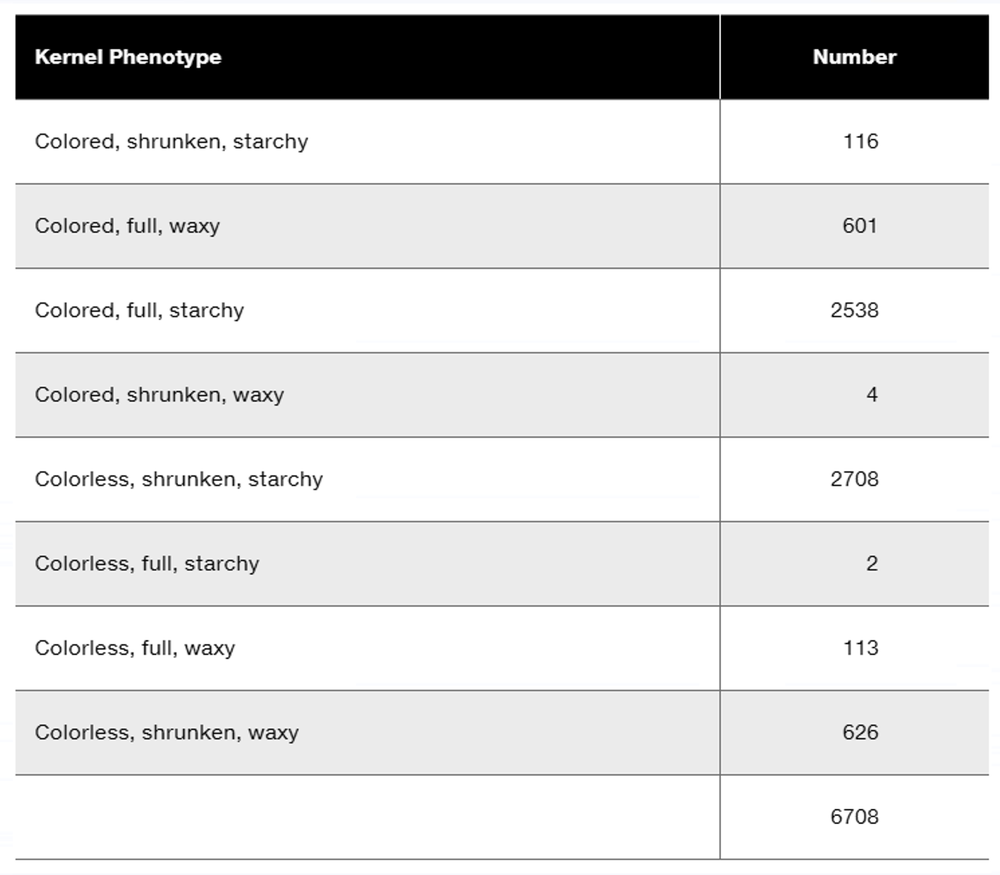
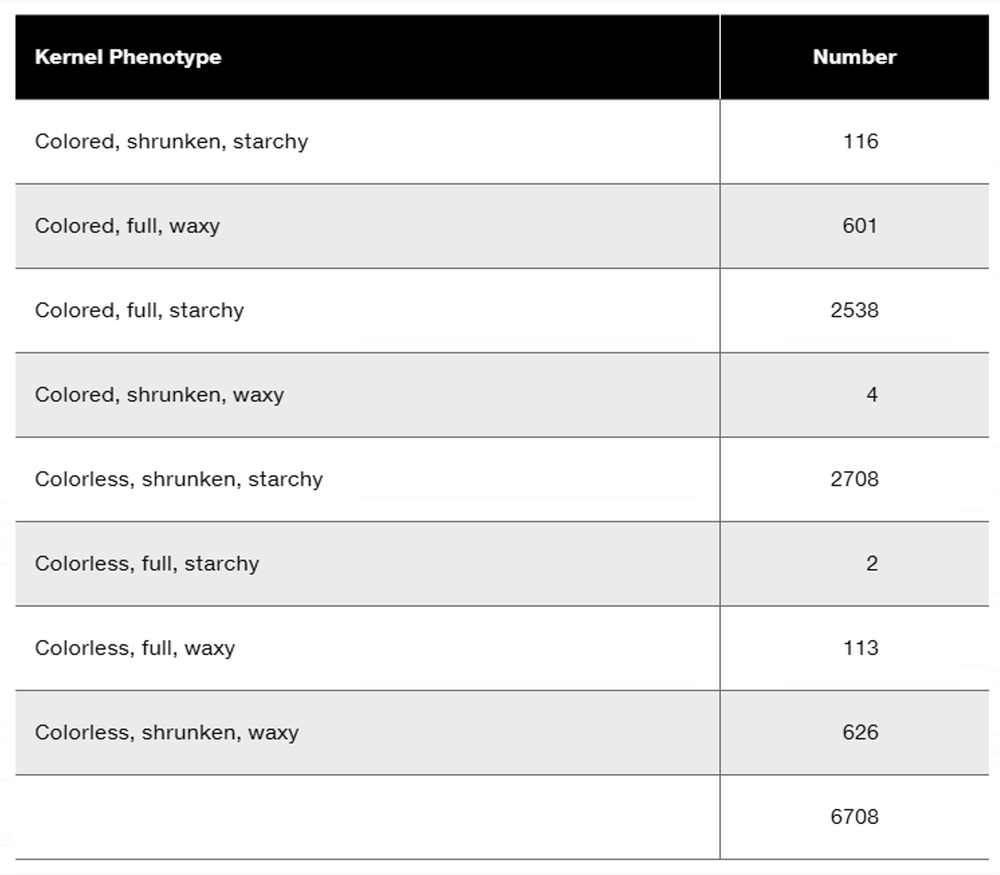
Researchers cross a corn plant that is pure-breeding for the dominant traits colored aleurone (C1), full kernel (Sh), and waxy endosperm (Wx) to a pure-breeding plant with the recessive traits colorless aleurone (c1), shrunken kernel (sh), and starchy (wx). The resulting F₁ plants were crossed to pure-breeding colorless, shrunken, starchy plants. Counting the kernels from about 30 ears of corn yields the following data.
Perform a chi-square test to determine if these data show significant deviation from the expected phenotype distribution.
Problema 13c
Researchers cross a corn plant that is pure-breeding for the dominant traits colored aleurone (C1), full kernel (Sh), and waxy endosperm (Wx) to a pure-breeding plant with the recessive traits colorless aleurone (c1), shrunken kernel (sh), and starchy (wx). The resulting F₁ plants were crossed to pure-breeding colorless, shrunken, starchy plants. Counting the kernels from about 30 ears of corn yields the following data.
What is the order of these genes in corn?
Problema 13d
Researchers cross a corn plant that is pure-breeding for the dominant traits colored aleurone (C1), full kernel (Sh), and waxy endosperm (Wx) to a pure-breeding plant with the recessive traits colorless aleurone (c1), shrunken kernel (sh), and starchy (wx). The resulting F₁ plants were crossed to pure-breeding colorless, shrunken, starchy plants. Counting the kernels from about 30 ears of corn yields the following data.
Calculate the recombination frequencies between the gene pairs.
Problema 13e
Researchers cross a corn plant that is pure-breeding for the dominant traits colored aleurone (C1), full kernel (Sh), and waxy endosperm (Wx) to a pure-breeding plant with the recessive traits colorless aleurone (c1), shrunken kernel (sh), and starchy (wx). The resulting F₁ plants were crossed to pure-breeding colorless, shrunken, starchy plants. Counting the kernels from about 30 ears of corn yields the following data.
What is the interference value for this data set?