Indietro
 Sanders 3rd EditionCh. 8 - Molecular Biology of Transcription and RNA Processing
Problema 1a
What is a gene?
Problema 1b
Why are genes for rRNA and tRNA considered to be genes even though they do not produce polypeptides?
Problema 2
In one to two sentences each, describe the three processes that commonly modify eukaryotic pre-mRNA.
Problema 3
Answer these questions concerning promoters. What role do promoters play in transcription?
Problema 3b
Answer these questions concerning promoters.
What is the common structure of a bacterial promoter with respect to consensus sequences?
Problema 3c
Answer these questions concerning promoters.
What consensus sequences are detected in the mammalian β-globin gene promoter?
Problema 3d
Answer these questions concerning promoters.
Eukaryotic promoters are more variable than bacterial promoters. Explain why.
Problema 3e
Answer these questions concerning promoters.
What is the meaning of the term alternative promoter? How does the use of alternative promoters affect transcription?
Problema 4a
The diagram below shows a DNA duplex. The template strand is identified, as is the location of the nucleotide.
Assume this region contains a gene transcribed in a bacterium. Identify the location of promoter consensus sequences and of the transcription termination sequence.
Problema 4b
The diagram below shows a DNA duplex. The template strand is identified, as is the location of the nucleotide. consensus sequences.
Assume this region contains a gene transcribed to form mRNA in a eukaryote. Identify the location of the most common promoter.
Problema 4c
The diagram below shows a DNA duplex. The template strand is identified, as is the location of the nucleotide.
If this region is a eukaryotic gene transcribed by RNA polymerase III, where are the promoter consensus sequences located?
Problema 5a
The following is a portion of an mRNA sequence:
3'-AUCGUCAUGCAGA-5'
During transcription, was the adenine at the left-hand side of the sequence the first or the last nucleotide used to build the portion of mRNA shown? Explain how you know.
Problema 5b
The following is a portion of an mRNA sequence:
3'-AUCGUCAUGCAGA-5'
Write out the sequence and polarity of the DNA duplex that encodes this mRNA segment. Label the template and coding DNA strands.
Problema 5c
The following is a portion of an mRNA sequence:
3'-AUCGUCAUGCAGA-5'
Identify the direction in which the promoter region for this gene will be located.
Problema 6
Compare and contrast the properties of DNA polymerase and RNA polymerase, listing at least three similarities and at least three differences between the molecules.
Problema 7a
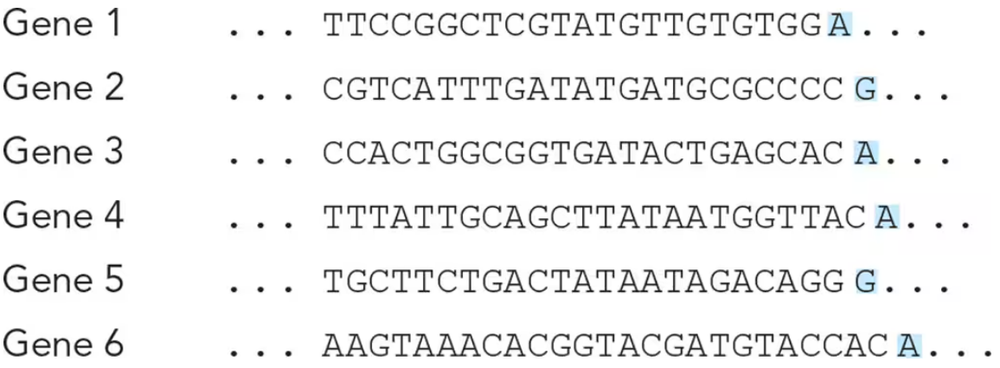
The DNA sequences shown below are from the promoter regions of six bacterial genes. In each case, the last nucleotide in the sequence (highlighted in blue) is the nucleotide that initiates transcription. Examine these sequences and identify the Pribnow box sequence at approximately -10 for each promoter.
Problema 7b
The DNA sequences shown below are from the promoter regions of six bacterial genes. In each case, the last nucleotide in the sequence (highlighted in blue) is the nucleotide that initiates transcription. Determine the consensus sequence for the Pribnow box from these sequences.
Problema 8
Bacterial and eukaryotic gene transcripts can differ—in the transcripts themselves, in whether the transcripts are modified before translation, and in how the transcripts are modified. For each of these three areas of contrast, describe what the differences are and why the differences exist.
Problema 9
Describe the two types of transcription termination found in bacterial genes. How does transcription termination differ for eukaryotic genes?
Problema 10
What is the role of enhancer sequences in transcription of eukaryotic genes? Speculate about why enhancers are not part of transcription of bacterial genes.
Problema 11
Describe the difference between introns and exons.
Problema 12
Draw a bacterial promoter and label its consensus sequences. How does this promoter differ from a eukaryotic promoter transcribed:
By RNA polymerase II?
By RNA polymerase I?
By RNA polymerase III?
Problema 13
For a eukaryotic gene whose transcription requires the activity of an enhancer sequence, explain how proteins bound at the enhancer interact with RNA pol II and transcription factors bound at the promoter.
Problema 14
Three genes identified in the diagram as A, B, and C are transcribed from a region of DNA. The 5'-to-3' transcription of genes A and C elongates mRNA in the right-to-left direction, and transcription of gene B elongates mRNA in the left-to-right direction. For each gene, identify the coding strand by designating it as an 'upper strand' or 'lower strand' in the diagram.
Problema 15a
The eukaryotic gene Gen-100 contains four introns labeled A to D. Imagine that Gen-100 has been isolated and its DNA has been denatured and mixed with polyadenylated mRNA from the gene.
Illustrate the R-loop structure that would be seen with electron microscopy.
Problema 15b
The eukaryotic gene Gen-100 contains four introns labeled A to D. Imagine that Gen-100 has been isolated and its DNA has been denatured and mixed with polyadenylated mRNA from the gene.
Label the introns.
Problema 15c
The eukaryotic gene Gen-100 contains four introns labeled A to D. Imagine that Gen-100 has been isolated and its DNA has been denatured and mixed with polyadenylated mRNA from the gene.
Are intron regions single stranded or double stranded? Why?
Problema 16a
The segment of the bacterial TrpA gene involved in intrinsic termination of transcription is the following:
3'-TGGGTCGGGGCGGATTACTGCCCCGAAAAAAAACTTG-5'
5'-ACCCAGCCCCGCCTAATGACGGGGCTTTTTTTTGAAC-3' Draw the mRNA structure that forms during transcription of this segment of the TrpA gene.
Problema 16b
The segment of the bacterial TrpA gene involved in intrinsic termination of transcription is the following:
3'-TGGGTCGGGGCGGATTACTGCCCCGAAAAAAAACTTG-5'
5'-ACCCAGCCCCGCCTAATGACGGGGCTTTTTTTTGAAC-3'
Label the template and coding DNA strands.
Problema 16c
The segment of the bacterial TrpA gene involved in intrinsic termination of transcription is the following:
3'-TGGGTCGGGGCGGATTACTGCCCCGAAAAAAAACTTG-5'
5'-ACCCAGCCCCGCCTAATGACGGGGCTTTTTTTTGAAC-3'
Explain how a sequence of this type leads to intrinsic termination of transcription.