Ch. 1 - The Molecular Basis of Heredity, Variation, and Evolution
Sanders - Genetic Analysis: An Integrated Approach 3rd Edition
Sanders3rd EditionGenetic Analysis: An Integrated ApproachISBN: 9780135564172Non è quello che usi tu?Cambia libro di testo
Capitolo 1, Problema 10j

Define each of the following terms:
Complementary base pair

Guida verificata passo dopo passo
1
Understand that complementary base pairing refers to the specific pairing of nitrogenous bases in DNA and RNA, which is essential for the structure and function of nucleic acids.
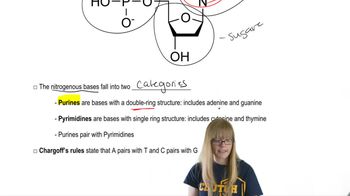
Recall that in DNA, adenine (A) pairs with thymine (T) through two hydrogen bonds, and cytosine (C) pairs with guanine (G) through three hydrogen bonds.
Note that in RNA, adenine (A) pairs with uracil (U) instead of thymine (T), while cytosine (C) still pairs with guanine (G).
Explain that complementary base pairing ensures accurate replication of DNA and proper transcription of RNA, maintaining genetic fidelity.
Summarize that complementary base pairs are a fundamental concept in molecular genetics, enabling the double-helix structure of DNA and the transfer of genetic information.

Risposta video verificata per un problema simile:

Questa soluzione video è stata consigliata dai nostri tutor come utile per risolvere questo problema.
Durata del video:
38s

Concetti chiave

Ecco i concetti essenziali che devi comprendere per rispondere correttamente alla domanda.

Complementary Base Pairing

Complementary base pairing refers to the specific pairing of nitrogenous bases in DNA and RNA. In DNA, adenine (A) pairs with thymine (T), and cytosine (C) pairs with guanine (G). This pairing is crucial for the structure of the double helix and ensures accurate replication and transcription of genetic information.
Video consigliato:
Percorso guidato
03:49
Base Distortions

DNA Structure

DNA is structured as a double helix, consisting of two strands that run in opposite directions. The backbone of each strand is made of sugar and phosphate groups, while the rungs are formed by complementary base pairs. This structure is essential for the stability of genetic material and the processes of replication and gene expression.
Video consigliato:

Base Pairing Rules

Base pairing rules dictate how nucleotides pair in nucleic acids. In DNA, A pairs with T and C pairs with G, while in RNA, A pairs with U (uracil) instead of T. These rules are fundamental for maintaining the integrity of genetic information during processes like DNA replication and RNA transcription.
Video consigliato:
Percorso guidato
03:49
Base Distortions