Ch. 10 - Eukaryotic Chromosome Abnormalities and Molecular Organization
Sanders - Genetic Analysis: An Integrated Approach 3rd Edition
Sanders3rd EditionGenetic Analysis: An Integrated ApproachISBN: 9780135564172Non è quello che usi tu?Cambia libro di testo
Capitolo 10, Problema 13e

An animal heterozygous for a reciprocal balanced translocation has the following chromosomes:
MN • OPQRST           
MN • OPQRjkl           
cdef • ghijkl           
cdef • ghiST
Among the three segregation patterns, which is least likely to occur? Why?

Guida verificata passo dopo passo
1
Understand the problem: A reciprocal balanced translocation involves the exchange of segments between two non-homologous chromosomes. The individual is heterozygous, meaning one set of chromosomes is normal, and the other set carries the translocation. The question asks about the least likely segregation pattern among the three possible patterns.
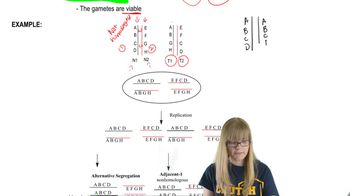
Recall the three possible segregation patterns for a heterozygous reciprocal translocation during meiosis: (1) Alternate segregation, (2) Adjacent-1 segregation, and (3) Adjacent-2 segregation. These patterns determine how the chromosomes separate into gametes.
Analyze the segregation patterns: (1) Alternate segregation produces gametes with either normal chromosomes or balanced translocation chromosomes, which are viable. (2) Adjacent-1 segregation involves the separation of homologous centromeres, leading to unbalanced gametes. (3) Adjacent-2 segregation involves the separation of non-homologous centromeres, also leading to unbalanced gametes.
Consider the likelihood of each pattern: Alternate segregation is the most common because it ensures balanced gametes. Adjacent-1 segregation is less common but still occurs. Adjacent-2 segregation is the least likely because it requires non-homologous centromeres to separate, which is less favorable during meiosis.
Conclude that Adjacent-2 segregation is the least likely to occur because it results in the highest degree of unbalanced gametes and is mechanically less favorable during meiotic division.

Risposta video verificata per un problema simile:

Questa soluzione video è stata consigliata dai nostri tutor come utile per risolvere questo problema.
Durata del video:
3m

Concetti chiave

Ecco i concetti essenziali che devi comprendere per rispondere correttamente alla domanda.

Heterozygous Reciprocal Balanced Translocation

A heterozygous reciprocal balanced translocation occurs when two non-homologous chromosomes exchange segments, resulting in a rearrangement of genetic material without loss. In this scenario, one chromosome carries the original segments, while the other carries the exchanged segments. This can lead to unique segregation patterns during meiosis, affecting gamete viability and genetic diversity.
Video consigliato:
Percorso guidato
12:42
Reciprocal Translocation

Segregation Patterns

Segregation patterns refer to the ways in which chromosomes are distributed into gametes during meiosis. In the case of a heterozygous translocation, different segregation patterns can arise, including alternate, adjacent-1, and adjacent-2 segregation. Each pattern has different implications for the genetic composition of the resulting gametes, influencing the likelihood of producing viable offspring.
Video consigliato:
Percorso guidato
11:19
Segmentation Genes

Viability of Gametes

The viability of gametes is crucial in understanding the outcomes of different segregation patterns. In the context of a reciprocal balanced translocation, certain segregation patterns may produce gametes with unbalanced genetic material, leading to non-viable embryos. Typically, alternate segregation produces viable gametes, while adjacent segregation patterns are more likely to result in aneuploidy, making them less favorable.
Video consigliato:
Percorso guidato
21:21
Gamete Development
Pratica correlata
Domanda del libro di testo

An animal heterozygous for a reciprocal balanced translocation has the following chromosomes:

      MN • OPQRST

      MN • OPQRjkl

      cdef • ghijkl

      cdef • ghiST

Identify the gametes produced by alternate segregation. Which, if any, of these gametes are viable?

519
views
Domanda del libro di testo

An animal heterozygous for a reciprocal balanced translocation has the following chromosomes:

      MN • OPQRST

      MN • OPQRjkl

      cdef • ghijkl

      cdef • ghiST

Identify the gametes produced by adjacent-2 segregation. Which if any of these gametes are viable?

538
views
Domanda del libro di testo

An animal heterozygous for a reciprocal balanced translocation has the following chromosomes:

      MN • OPQRST

      MN • OPQRjkl

      cdef • ghijkl

      cdef • ghiST

Identify the gametes produced by adjacent-1 segregation. Which, if any, of these gametes are viable?

497
views
Domanda del libro di testo

Dr. Ara B. Dopsis has an idea he thinks will be a boon to agriculture. He wants to create the 'pomato,' a hybrid between a tomato (Lycopersicon esculentum) that has 12 chromosomes and a potato (Solanum tuberosum) that has 48 chromosomes. Dr. Dopsis is hoping his new pomato will have tuber growth like a potato and the fruit production of a tomato. He joins a haploid gamete from each species to form a hybrid and then induces doubling of chromosome number. How many chromosomes will the hybrid have before chromosome doubling?

426
views
Domanda del libro di testo

Dr. Ara B. Dopsis has an idea he thinks will be a boon to agriculture. He wants to create the 'pomato,' a hybrid between a tomato (Lycopersicon esculentum) that has 12 chromosomes and a potato (Solanum tuberosum) that has 48 chromosomes. Dr. Dopsis is hoping his new pomato will have tuber growth like a potato and the fruit production of a tomato. He joins a haploid gamete from each species to form a hybrid and then induces doubling of chromosome number.

How many chromosomes will the polyploid have after chromosome doubling?

471
views
Domanda del libro di testo

Dr. Ara B. Dopsis has an idea he thinks will be a boon to agriculture. He wants to create the 'pomato,' a hybrid between a tomato (Lycopersicon esculentum) that has 12 chromosomes and a potato (Solanum tuberosum) that has 48 chromosomes. Dr. Dopsis is hoping his new pomato will have tuber growth like a potato and the fruit production of a tomato. He joins a haploid gamete from each species to form a hybrid and then induces doubling of chromosome number. Will this hybrid be infertile?

379
views