Domanda del libro di testo
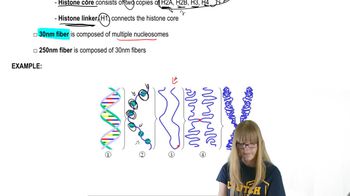
In eukaryotic DNA, how does the role of H1 differ from the role of H3 in chromatin formation?
735
views

 Sanders 3rd EditionCh. 10 - Eukaryotic Chromosome Abnormalities and Molecular OrganizationProblema 4
 Guida verificata passo dopo passo
 07:10
07:10
 07:11
07:11 11:11
11:11In eukaryotic DNA, how does the role of H1 differ from the role of H3 in chromatin formation?
From the following list, identify the types of chromosome changes you expect to show phenotypic consequences. duplication
Consider synapsis in prophase I of meiosis for two plant species that each carries 36 chromosomes. Species A is diploid and species B is triploid. What characteristics of homologous chromosome synapsis can be used to distinguish these two species?
In eukaryotic DNA, where are you most likely to find histone protein H1?
In eukaryotic DNA, along a 6000-bp segment of DNA, approximately how many molecules of each kind of histone protein do you expect to find? Explain your answer.
Human late prophase karyotypes have about 2000 visible G bands. The human genome contains approximately 22,000 genes. Consider the region 5p1.5 through the end of the short arm of chromosome 5, which is identified on the late prophase chromosome in Figure 10.5, and assume the entire region is deleted. Approximately how many genes will be lost as a result of the deletion?