Ch. 11 - Gene Mutation, DNA Repair, and Homologous Recombination
Sanders - Genetic Analysis: An Integrated Approach 3rd Edition
Sanders3rd EditionGenetic Analysis: An Integrated ApproachISBN: 9780135564172Non è quello che usi tu?Cambia libro di testo
Capitolo 11, Problema 7b

Researchers interested in studying mutation and mutation repair often induce mutations with various agents. What kinds of gene mutations are induced by
Radiation energy? Give two examples.

Guida verificata passo dopo passo
1
Understand the concept of gene mutations: Gene mutations are changes in the nucleotide sequence of DNA. These mutations can be induced by external factors such as radiation energy, which causes damage to the DNA structure.
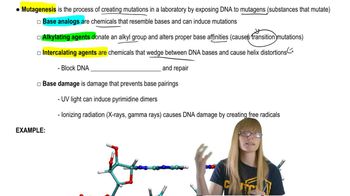
Learn about the types of radiation energy: Radiation energy can be classified into ionizing radiation (e.g., X-rays, gamma rays) and non-ionizing radiation (e.g., UV light). Both types can induce mutations in DNA.
Explore the effects of ionizing radiation: Ionizing radiation can cause double-strand breaks in DNA, leading to chromosomal rearrangements or deletions. It can also result in point mutations by altering individual nucleotides.
Examine the effects of non-ionizing radiation: UV light, a form of non-ionizing radiation, can induce the formation of pyrimidine dimers (e.g., thymine dimers). These dimers disrupt normal base pairing and replication, leading to mutations.
Summarize two examples of mutations induced by radiation energy: Example 1: Double-strand breaks caused by ionizing radiation. Example 2: Pyrimidine dimers caused by UV light. These mutations can lead to errors during DNA repair or replication.

Risposta video verificata per un problema simile:

Questa soluzione video è stata consigliata dai nostri tutor come utile per risolvere questo problema.
Durata del video:
3m

Concetti chiave

Ecco i concetti essenziali che devi comprendere per rispondere correttamente alla domanda.

Types of Gene Mutations

Gene mutations can be classified into several types, including point mutations, insertions, deletions, and frameshift mutations. Point mutations involve a change in a single nucleotide, while insertions and deletions add or remove nucleotides, potentially altering the reading frame of the gene. Understanding these types is crucial for identifying how radiation can induce specific mutations.
Video consigliato:
Percorso guidato
10:48
Mutations and Phenotypes

Mechanisms of Radiation-Induced Mutations

Radiation energy, such as ultraviolet (UV) light or ionizing radiation, can cause mutations by damaging the DNA structure. UV light can lead to the formation of pyrimidine dimers, which disrupt normal base pairing, while ionizing radiation can cause double-strand breaks. These alterations can result in various mutations if not properly repaired by cellular mechanisms.
Video consigliato:
Percorso guidato
04:29
Induced Mutations

Mutation Repair Mechanisms

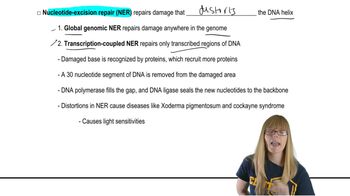
Cells have evolved several mechanisms to repair mutations, including nucleotide excision repair (NER) and homologous recombination. NER is particularly important for fixing UV-induced damage, while homologous recombination repairs double-strand breaks. Understanding these repair processes is essential for comprehending how cells maintain genetic stability despite exposure to mutagens like radiation.
Video consigliato:
Percorso guidato
05:44
Repair Pathways