Ch. 11 - Gene Mutation, DNA Repair, and Homologous Recombination
Sanders - Genetic Analysis: An Integrated Approach 3rd Edition
Sanders3rd EditionGenetic Analysis: An Integrated ApproachISBN: 9780135564172Non è quello che usi tu?Cambia libro di testo
Capitolo 11, Problema 14e

Several types of mutation are identified and described in the chapter. These include (1) promoter mutation, (2) splice site mutation, (3) missense mutation, (4) frameshift mutation, and 5) nonsense mutation. Match the following mutation descriptions with the type(s) of mutations listed above. More than one mutation type might match a description.


A null mutation that does not produce any functional protein product.

Guida verificata passo dopo passo
1
Understand the term 'null mutation': A null mutation is a type of mutation that results in the complete loss of function of the gene product. This means no functional protein is produced.
Review the mutation types provided: (1) promoter mutation, (2) splice site mutation, (3) missense mutation, (4) frameshift mutation, and (5) nonsense mutation. Consider how each type of mutation could lead to a null mutation.
Analyze nonsense mutations: A nonsense mutation introduces a premature stop codon in the coding sequence, leading to a truncated and likely nonfunctional protein. This can result in a null mutation.
Analyze frameshift mutations: A frameshift mutation alters the reading frame of the gene, often leading to a completely different and nonfunctional protein. This can also result in a null mutation.
Consider other mutation types: Promoter mutations and splice site mutations can disrupt gene expression or mRNA processing, potentially leading to no protein being produced. These could also result in a null mutation depending on the severity of the disruption.

Risposta video verificata per un problema simile:

Questa soluzione video è stata consigliata dai nostri tutor come utile per risolvere questo problema.
Durata del video:
1m

Concetti chiave

Ecco i concetti essenziali che devi comprendere per rispondere correttamente alla domanda.

Nonsense Mutation

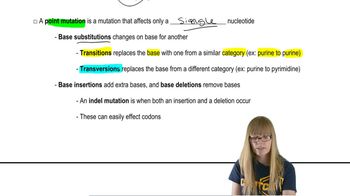
A nonsense mutation is a type of point mutation where a single nucleotide change results in a premature stop codon in the coding sequence of a gene. This leads to the production of a truncated protein that is usually nonfunctional, effectively resulting in a null mutation. Understanding this mutation is crucial for recognizing how genetic information can be disrupted, leading to loss of function.
Video consigliato:
Percorso guidato
09:49
Point Mutations

Null Mutation

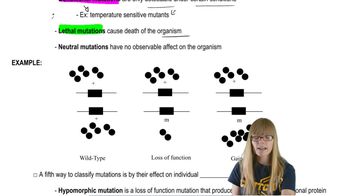
A null mutation refers to any mutation that results in the complete loss of function of a gene product. This can occur through various mechanisms, including nonsense mutations, frameshift mutations, or deletions that eliminate essential coding sequences. Recognizing null mutations is important for studying gene function and the effects of genetic disorders.
Video consigliato:
Percorso guidato
10:48
Mutations and Phenotypes

Frameshift Mutation

A frameshift mutation occurs when nucleotides are inserted or deleted from the DNA sequence, causing a shift in the reading frame of the genetic code. This alteration can lead to the production of entirely different amino acids downstream of the mutation, often resulting in a nonfunctional protein. Frameshift mutations can also create premature stop codons, contributing to null mutations.
Video consigliato:
Percorso guidato
09:49
Point Mutations
Pratica correlata
Domanda del libro di testo

Several types of mutation are identified and described in the chapter. These include (1) promoter mutation, (2) splice site mutation, (3) missense mutation, (4) frameshift mutation, and 5) nonsense mutation. Match the following mutation descriptions with the type(s) of mutations listed above. More than one mutation type might match a description.


A mutation that produces a protein that is shorter than the wild-type protein but does not have any amino acid changes in the portion produced.

620
views
Domanda del libro di testo

A strain of E. coli is identified as having a null mutation of the RecA gene. What biological property do you expect to be absent in the mutant strain? What is the molecular basis for the missing property?

471
views
Domanda del libro di testo

Several types of mutation are identified and described in the chapter. These include (1) promoter mutation, (2) splice site mutation, (3) missense mutation, (4) frameshift mutation, and 5) nonsense mutation. Match the following mutation descriptions with the type(s) of mutations listed above. More than one mutation type might match a description.


A mutation that produces about 5% of the wild-type amount of an mRNA.

563
views
Domanda del libro di testo

A 1-mL sample of the bacterium E. coli is exposed to ultraviolet light. The sample is used to inoculate a 500-mL flask of complete medium that allows growth of all bacterial cells. The 500-mL culture is grown on the benchtop, and two equal-sized samples are removed and plated on identical complete-medium growth plates. Plate 1 is immediately wrapped in a dark cloth, but plate 2 is not covered. Both plates are left at room temperature for 36 hours and then examined. Plate 2 is seen to contain many more growing colonies than plate 1.

Thinking about DNA repair processes, how do you explain this observation?

478
views
Domanda del libro di testo

Describe the difference between DNA transposons and retrotransposons.

727
views
Domanda del libro di testo

Several types of mutation are identified and described in the chapter. These include (1) promoter mutation, (2) splice site mutation, (3) missense mutation, (4) frameshift mutation, and 5) nonsense mutation. Match the following mutation descriptions with the type(s) of mutations listed above. More than one mutation type might match a description.


A mutation that produces a mutant protein that differs from the wild-type protein at one amino acid position.

997
views