Ch. 11 - Gene Mutation, DNA Repair, and Homologous Recombination
Sanders - Genetic Analysis: An Integrated Approach 3rd Edition
Sanders3rd EditionGenetic Analysis: An Integrated ApproachISBN: 9780135564172Non è quello che usi tu?Cambia libro di testo
Capitolo 11, Problema 19a

Using the adenine–thymine base pair in this DNA sequence
...GCTC...
...CGAG...
Give the sequence after a transition mutation.

Guida verificata passo dopo passo
1
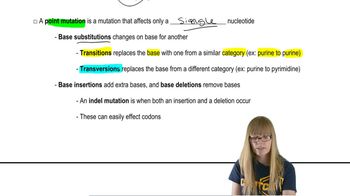
Step 1: Understand the concept of a transition mutation. A transition mutation is a type of point mutation where a purine (adenine or guanine) is replaced with another purine, or a pyrimidine (cytosine or thymine) is replaced with another pyrimidine.
Step 2: Analyze the provided DNA sequence before the mutation. The original sequence is: CCTTAGGATTCC (top strand) and GGAATCCTAAGG (bottom strand).
Step 3: Observe the mutation in the image. The sequence changes from CCTTAGGATTCC to CCTCAGGATTCC (top strand) and GGAATCCTAAGG to GGAGTCCTAAGG (bottom strand).
Step 4: Identify the specific base pair affected by the transition mutation. In the top strand, the second 'T' in the sequence changes to 'C', and in the bottom strand, the corresponding 'A' changes to 'G'. This is consistent with a transition mutation.
Step 5: Write the mutated sequence. After the transition mutation, the new sequence is: CCTCAGGATTCC (top strand) and GGAGTCCTAAGG (bottom strand).

Risposta video verificata per un problema simile:

Questa soluzione video è stata consigliata dai nostri tutor come utile per risolvere questo problema.
Durata del video:
1m

Concetti chiave

Ecco i concetti essenziali che devi comprendere per rispondere correttamente alla domanda.

Transition Mutation

A transition mutation is a specific type of point mutation where a purine base (adenine or guanine) is replaced by another purine, or a pyrimidine base (cytosine or thymine) is replaced by another pyrimidine. This type of mutation can lead to changes in the amino acid sequence of proteins, potentially affecting their function. In the provided example, the mutation changes a 'C' to a 'T', illustrating this concept.
Video consigliato:
Percorso guidato
09:49
Point Mutations

DNA Base Pairing

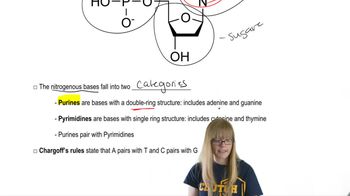
DNA base pairing refers to the specific pairing of nitrogenous bases in the DNA double helix, where adenine pairs with thymine (A-T) and cytosine pairs with guanine (C-G). This complementary base pairing is crucial for DNA replication and transcription, ensuring genetic information is accurately passed on. Understanding base pairing is essential for analyzing mutations, as changes in one base can affect the entire sequence.
Video consigliato:

Effects of Mutations

Mutations can have various effects on an organism, ranging from benign to harmful. They can alter protein structure and function, potentially leading to diseases or changes in traits. In the context of the question, understanding how a transition mutation affects the DNA sequence helps predict the potential impact on the resulting protein and the organism's phenotype.
Video consigliato:
Percorso guidato
03:38
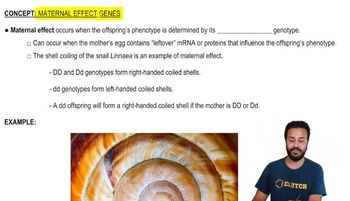
Maternal Effect