Nitrous acid and 5-bromodeoxyuracil (BrdU) alter DNA by different mechanisms. What type of mutation does each compound produce?
Ch. 11 - Gene Mutation, DNA Repair, and Homologous Recombination

Sanders3rd EditionGenetic Analysis: An Integrated ApproachISBN: 9780135564172Non è quello che usi tu?Cambia libro di testo
Tutti i libri di testo
Sanders 3rd Edition
Ch. 11 - Gene Mutation, DNA Repair, and Homologous Recombination
Problema 3
Sanders 3rd Edition
Ch. 11 - Gene Mutation, DNA Repair, and Homologous Recombination
Problema 3Capitolo 11, Problema 3
What is the difference between a transition mutation and a transversion mutation?
Guida verificata passo dopo passo1
Understand that mutations are changes in the DNA sequence, and they can be classified based on the type of nucleotide change.
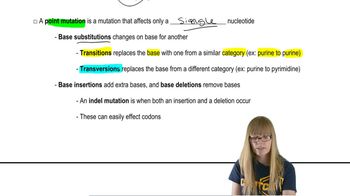
Recognize that a transition mutation is a type of point mutation where a purine is replaced with another purine (A ↔ G) or a pyrimidine is replaced with another pyrimidine (C ↔ T).
Identify that a transversion mutation is another type of point mutation where a purine is replaced with a pyrimidine or vice versa (A or G ↔ C or T).
Note that transitions are more common than transversions because they involve less drastic changes in the DNA structure.
Consider the implications of these mutations: transitions may have less impact on the protein function compared to transversions, which can lead to more significant changes in the amino acid sequence.

Risposta video verificata per un problema simile:
Questa soluzione video è stata consigliata dai nostri tutor come utile per risolvere questo problema.
Durata del video:
2mConcetti chiave
Ecco i concetti essenziali che devi comprendere per rispondere correttamente alla domanda.
Transition Mutation
A transition mutation is a type of point mutation where a purine base (adenine or guanine) is replaced by another purine, or a pyrimidine base (cytosine or thymine) is replaced by another pyrimidine. This type of mutation is more common than transversion mutations and often has less impact on the protein structure, as it maintains the same class of nucleotide.
Video consigliato:
Percorso guidato
Point Mutations
Transversion Mutation
A transversion mutation is another type of point mutation, but it involves the substitution of a purine for a pyrimidine or vice versa. This means that adenine or guanine can be replaced by cytosine or thymine, leading to a more significant change in the DNA sequence. Transversions are less frequent than transitions and can have a greater impact on the resulting protein.
Video consigliato:
Percorso guidato
Point Mutations
Impact on Protein Function
Both transition and transversion mutations can affect protein function, but their impacts can vary. Transition mutations are often less disruptive due to the preservation of the nucleotide class, while transversions can lead to more drastic changes in amino acid sequences, potentially altering protein structure and function. Understanding these differences is crucial for predicting the effects of mutations in genetic studies.
Video consigliato:
Percorso guidato
Proteins
Pratica correlata
Domanda del libro di testo
603
views
Domanda del libro di testo
Identify two general ways chemical mutagens can alter DNA. Give examples of these two mechanisms.
655
views
Domanda del libro di testo
What are the differences between a synonymous mutation, a missense mutation, and a nonsense mutation?
916
views
Domanda del libro di testo
UV irradiation causes damage to bacterial DNA. What kind of damage is frequently caused and how does photolyase repair the damage?
788
views
Domanda del libro di testo
For the retinal cancer retinoblastoma, the inheritance of one mutated copy of RB1 from one of the parents is often referred to as a mutation that produces a 'dominant predisposition to cancer.' This means that the first mutation does not produce cancer but makes it very likely that cancer will develop. Define the 'two-hit hypothesis' for retinoblastoma.
521
views