Ch. 11 - Gene Mutation, DNA Repair, and Homologous Recombination
Sanders - Genetic Analysis: An Integrated Approach 3rd Edition
Sanders3rd EditionGenetic Analysis: An Integrated ApproachISBN: 9780135564172Non è quello che usi tu?Cambia libro di testo
Capitolo 11, Problema 12

What is the phenotypic effect of inserting a Ds element into the maize C gene? How do Ds and Ac produce maize kernels that are mostly yellow with purple spots?

Guida verificata passo dopo passo
1
Understand the role of the C gene in maize: The C gene in maize is responsible for the production of anthocyanin, a pigment that gives the kernels their purple color. If the C gene is functional, the kernels will be purple. If the C gene is disrupted, the kernels will be yellow due to the absence of anthocyanin production.
Explain the Ds (Dissociation) element: The Ds element is a transposable element that can insert itself into the genome. When Ds inserts into the C gene, it disrupts the gene's function, preventing the production of anthocyanin and resulting in yellow kernels.
Describe the role of the Ac (Activator) element: The Ac element is another transposable element that provides the transposase enzyme required for the Ds element to move. Without Ac, Ds remains stationary, and the C gene remains disrupted. With Ac present, Ds can excise itself from the C gene, potentially restoring the gene's function.
Explain the phenotypic effect of Ds and Ac interaction: In kernels where Ac is present, Ds can excise from the C gene during kernel development. If Ds excises early in development, the C gene's function is restored in some cells, leading to the production of anthocyanin and the appearance of purple spots on the otherwise yellow kernel. The timing and frequency of Ds excision determine the size and number of purple spots.
Summarize the overall effect: The insertion of Ds into the C gene results in yellow kernels due to the disruption of anthocyanin production. However, in the presence of Ac, the excision of Ds during development can restore the C gene's function in some cells, leading to a spotted phenotype with purple spots on a yellow background.

Risposta video verificata per un problema simile:

Questa soluzione video è stata consigliata dai nostri tutor come utile per risolvere questo problema.
Durata del video:
2m

Concetti chiave

Ecco i concetti essenziali che devi comprendere per rispondere correttamente alla domanda.

Transposable Elements

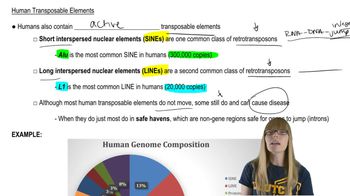
Transposable elements, or 'jumping genes,' are DNA sequences that can change their position within the genome. In maize, the Dissociation (Ds) element is a type of transposable element that can disrupt gene function when inserted into a gene, such as the C gene, affecting the phenotype of the organism.
Video consigliato:
Percorso guidato
05:30
Human Transposable Elements

C Gene and Kernel Color

The C gene in maize is responsible for the production of anthocyanin pigments, which contribute to the color of the kernels. When the Ds element inserts into the C gene, it can lead to a loss of function, resulting in kernels that are yellow due to the absence of pigment, with purple spots appearing where the gene is still active.
Video consigliato:

Activator (Ac) and Dissociation (Ds) Interaction

The Ac element acts as an activator of the Ds element, facilitating its movement and insertion into various locations in the genome. This interaction can lead to a mosaic pattern of kernel coloration, where some kernels are yellow and others have purple spots, depending on the activity of the C gene and the presence of the Ac element.
Video consigliato:
Percorso guidato
07:56
Interacting Genes Overview
Pratica correlata
Domanda del libro di testo

Two different mutations are identified in a haploid strain of yeast. The first prevents the synthesis of adenine by a nonsense mutation of the ade-1 gene. In this mutation, a base-pair substitution changes a tryptophan codon (UGG) to a stop codon (UGA). The second affects one of several duplicate tRNA genes. This base-pair substitution mutation changes the anticodon sequence of a tRNAᵀʳᵖ from


   3′−ACC−5′ to 3′−ACU−5′


Assuming there are no other mutations in the genome, will this double-mutant yeast strain be able to grow on minimal medium? If growth will occur, characterize the nature of growth relative to wild type.

493
views
Domanda del libro di testo

Two different mutations are identified in a haploid strain of yeast. The first prevents the synthesis of adenine by a nonsense mutation of the ade-1 gene. In this mutation, a base-pair substitution changes a tryptophan codon (UGG) to a stop codon (UGA). The second affects one of several duplicate tRNA genes. This base-pair substitution mutation changes the anticodon sequence of a tRNAᵀʳᵖ from


   3′−ACC−5′ to 3′−ACU−5′


Do you consider the first mutation to be a forward mutation or a reversion? Why?

470
views
Domanda del libro di testo

Answer the following questions concerning the accuracy of DNA polymerase during replication.

If a DNA replication error is detected by DNA polymerase, how is it corrected?

419
views
Domanda del libro di testo

Two different mutations are identified in a haploid strain of yeast. The first prevents the synthesis of adenine by a nonsense mutation of the ade-1 gene. In this mutation, a base-pair substitution changes a tryptophan codon (UGG) to a stop codon (UGA). The second affects one of several duplicate tRNA genes. This base-pair substitution mutation changes the anticodon sequence of a tRNAᵀʳᵖ from


   3′−ACC−5′ to 3′−ACU−5′


Do you consider the second mutation to be a forward mutation or a reversion? Why?

523
views
Domanda del libro di testo

Answer the following questions concerning the accuracy of DNA polymerase during replication.

If a replication error escapes detection and correction, what kind of abnormality is most likely to exist at the site of the replication error?

438
views
Domanda del libro di testo

Answer the following questions concerning the accuracy of DNA polymerase during replication.

What general mechanism do DNA polymerases use to check the accuracy of DNA replication and identify errors during replication?

500
views