Ch. 14 - Analysis of Gene Function via Forward Genetics and Reverse Genetics
Sanders - Genetic Analysis: An Integrated Approach 3rd Edition
Sanders3rd EditionGenetic Analysis: An Integrated ApproachISBN: 9780135564172Non è quello che usi tu?Cambia libro di testo
Capitolo 14, Problema C.2a

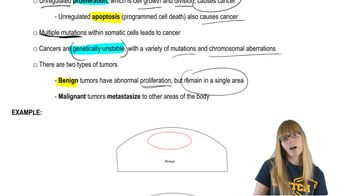
A tumor is a growing mass of abnormal cells. Describe the difference between a benign tumor and a malignant tumor.

Guida verificata passo dopo passo
1
Step 1: Understand the definition of a tumor as a mass of abnormal cells that grow uncontrollably.
Step 2: Define a benign tumor as a non-cancerous growth that typically grows slowly and does not spread to other parts of the body.
Step 3: Define a malignant tumor as a cancerous growth that can grow rapidly, invade nearby tissues, and has the potential to spread (metastasize) to distant parts of the body.
Step 4: Highlight that benign tumors are usually encapsulated and less likely to cause serious harm, whereas malignant tumors are invasive and can disrupt normal body functions.
Step 5: Summarize the key difference: benign tumors remain localized and are generally less dangerous, while malignant tumors are aggressive and can spread, making them more harmful.

Risposta video verificata per un problema simile:

Questa soluzione video è stata consigliata dai nostri tutor come utile per risolvere questo problema.
Durata del video:
2m

Concetti chiave

Ecco i concetti essenziali che devi comprendere per rispondere correttamente alla domanda.

Benign Tumor

A benign tumor is a non-cancerous growth of abnormal cells that remains localized and does not invade surrounding tissues or spread to other parts of the body. These tumors usually grow slowly and are often encapsulated, making them less harmful and easier to remove.
Video consigliato:
Percorso guidato
09:46
Cancer Characteristics

Malignant Tumor

A malignant tumor is a cancerous growth characterized by uncontrolled cell division, invasion into nearby tissues, and the potential to metastasize, or spread, to distant organs. Malignant tumors are aggressive, can disrupt normal body functions, and often require more intensive treatment.
Video consigliato:
Percorso guidato
09:46
Cancer Characteristics

Tumor Growth and Metastasis

Tumor growth involves abnormal cell proliferation, but only malignant tumors have the ability to metastasize, meaning cancer cells break away, travel through the bloodstream or lymphatic system, and form new tumors elsewhere. This process distinguishes malignant tumors from benign ones and impacts prognosis and treatment.
Video consigliato:
Percorso guidato
09:46
Cancer Characteristics
Pratica correlata
Domanda del libro di testo

A tumor is a growing mass of abnormal cells. Give an example from this chapter of a benign tumor that becomes a malignant tumor.

444
views
Domanda del libro di testo

For the retinal cancer retinoblastoma, the inheritance of one mutated copy of RB1 from one of the parents is often referred to as a mutation that produces a 'dominant predisposition to cancer.' This means that the first mutation does not produce cancer but makes it very likely that cancer will develop.

Explain why cancer is almost certain to develop with the inheritance of one mutated copy of RB1.

577
views
Domanda del libro di testo

Discuss the similarities and differences between forward and reverse genetic approaches, and when you would choose to utilize each of the approaches.

781
views
Domanda del libro di testo

You conduct a study in which the transcriptional fusion of regulatory sequences of a particular gene with a reporter gene results in relatively uniform expression of the reporter gene in all cells of an organism. A translational fusion with the same gene shows reporter gene expression only in the nucleus of a specific cell type. Discuss some biological causes for the difference in expression patterns of the two transgenes.

513
views
Domanda del libro di testo

Go to the National Institute for Child Health and Human Development (http://www.nichd.nih.gov), locate the search box at the top right corner of the homepage, and enter 'RUSP' to search for information on the Recommended Uniform Screening Panel. From the options that appear, select 'Brief History of Newborn Screening' and locate the discussion listing the criteria for adding a disease to the RUSP list. What are the criteria for listing a disease on the RUSP list?

427
views
Domanda del libro di testo

A tumor is a growing mass of abnormal cells. What must happen for a benign tumor to become malignant?

681
views