Ch. 14 - Analysis of Gene Function via Forward Genetics and Reverse Genetics
Sanders - Genetic Analysis: An Integrated Approach 3rd Edition
Sanders3rd EditionGenetic Analysis: An Integrated ApproachISBN: 9780135564172Non è quello che usi tu?Cambia libro di testo
Capitolo 14, Problema C.11d

Go to the website http://www.ncbi.nlm.nih.gov/omim and enter 'Lynch syndrome' in the Search box at the top of the page. From the list of options given, select '#120435—Lynch Syndrome.' Use the information you retrieve to answer the following questions. What are the approximate rates of cancer that develop in people carrying a mutation of one of these genes?

Guida verificata passo dopo passo
1
Understand that Lynch syndrome is a hereditary condition caused by mutations in mismatch repair genes, which significantly increase the risk of certain cancers, especially colorectal and endometrial cancers.
Navigate to the NCBI OMIM website and enter 'Lynch syndrome' in the search box to find detailed genetic and clinical information about the syndrome.
Select the entry '#120435—Lynch Syndrome' to access comprehensive data, including gene mutations involved and associated cancer risks.
Locate the section within the OMIM entry that discusses cancer risks or penetrance, which typically provides approximate percentages or rates of cancer development in mutation carriers.
Interpret the data by noting the approximate lifetime risk percentages for different types of cancers (e.g., colorectal, endometrial) in individuals with Lynch syndrome gene mutations, understanding that these rates reflect increased susceptibility compared to the general population.

Risposta video verificata per un problema simile:

Questa soluzione video è stata consigliata dai nostri tutor come utile per risolvere questo problema.
Durata del video:
2m

Concetti chiave

Ecco i concetti essenziali che devi comprendere per rispondere correttamente alla domanda.

Lynch Syndrome and Its Genetic Basis

Lynch syndrome is an inherited disorder caused by mutations in DNA mismatch repair genes, such as MLH1, MSH2, MSH6, and PMS2. These mutations increase the risk of developing certain cancers, especially colorectal and endometrial cancers, by impairing the cell's ability to correct DNA replication errors.
Video consigliato:
Percorso guidato
07:39
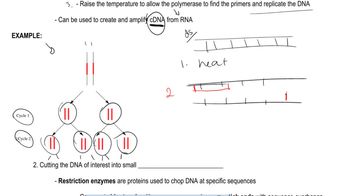
Genetic Cloning

Cancer Penetrance in Mutation Carriers

Penetrance refers to the proportion of individuals with a specific genetic mutation who exhibit the associated disease. In Lynch syndrome, penetrance is expressed as the approximate lifetime risk or rate of developing cancer among mutation carriers, which varies depending on the gene mutated and other factors.
Video consigliato:
Percorso guidato
04:46
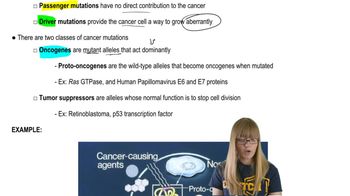
Cancer Mutations

Using OMIM Database for Genetic Information

OMIM (Online Mendelian Inheritance in Man) is a comprehensive database cataloging human genes and genetic disorders. It provides detailed information on gene mutations, associated phenotypes, and epidemiological data, such as cancer risk rates in Lynch syndrome, enabling researchers and students to access reliable genetic information.
Video consigliato:
Percorso guidato
09:03
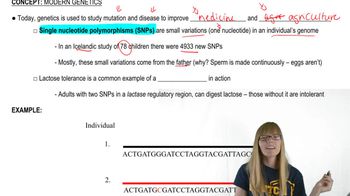
Modern Genetics
Pratica correlata
Domanda del libro di testo

You have identified a gene encoding the protein involved in the rate-limiting step in vitamin E biosynthesis. How would you create a transgenic plant producing large quantities of vitamin E in its seeds?

574
views
Domanda del libro di testo

What kind of information will be made available by The Cancer Genome Atlas (TCGA)? What sort of role do you think TCGA information will play in cancer diagnosis and cancer treatment in the future?

620
views
Domanda del libro di testo

Go to the website http://www.ncbi.nlm.nih.gov/omim and enter 'Lynch syndrome' in the Search box at the top of the page. From the list of options given, select '#120435—Lynch Syndrome.' Use the information you retrieve to answer the following questions. Provide a brief summary of the normal functions of the protein products of these genes.

387
views
Domanda del libro di testo

You have identified a recessive mutation that alters bristle patterning in Drosophila and have used recombinant DNA technology to identify a genomic clone that you believe harbors the gene. How would you demonstrate that your gene is on the genomic clone?

433
views
Domanda del libro di testo

Go to the website http://www.ncbi.nlm.nih.gov/omim and enter 'Lynch syndrome' in the Search box at the top of the page. From the list of options given, select '#120435—Lynch Syndrome.' Use the information you retrieve to answer the following questions. There are two types of Lynch syndrome. What are they?

456
views
Domanda del libro di testo

Go to the website http://www.ncbi.nlm.nih.gov/omim and enter 'Lynch syndrome' in the Search box at the top of the page. From the list of options given, select '#120435—Lynch Syndrome.' Use the information you retrieve to answer the following questions. What genes are most commonly mutated in Lynch syndrome?

502
views