Ch. 14 - Analysis of Gene Function via Forward Genetics and Reverse Genetics
Sanders - Genetic Analysis: An Integrated Approach 3rd Edition
Sanders3rd EditionGenetic Analysis: An Integrated ApproachISBN: 9780135564172Non è quello che usi tu?Cambia libro di testo
Capitolo 14, Problema C.8b

The inheritance of certain mutations of BRCA1 can make it much more likely that a woman will develop breast or ovarian cancer in her lifetime. In addition to inheriting a BRCA1 mutation, what else must happen for a woman to develop breast or ovarian cancer?

Guida verificata passo dopo passo
1
Understand that BRCA1 is a tumor suppressor gene, which means it helps regulate cell growth and prevent cancer by repairing DNA damage.
Recognize that inheriting a mutation in one copy of the BRCA1 gene (germline mutation) increases cancer risk but is not sufficient alone to cause cancer.
Learn about the 'two-hit hypothesis' which states that both copies of a tumor suppressor gene must be inactivated for cancer to develop.
Identify that the second 'hit' usually involves a somatic mutation or loss of the normal BRCA1 allele in the cells of breast or ovarian tissue.
Conclude that in addition to inheriting a BRCA1 mutation, a woman must acquire a second mutation or loss of function in the other BRCA1 allele in relevant cells for cancer to develop.

Risposta video verificata per un problema simile:

Questa soluzione video è stata consigliata dai nostri tutor come utile per risolvere questo problema.
Durata del video:
1m

Concetti chiave

Ecco i concetti essenziali che devi comprendere per rispondere correttamente alla domanda.

BRCA1 Gene and Its Role in Cancer

BRCA1 is a tumor suppressor gene involved in DNA repair. Mutations in BRCA1 impair this repair function, increasing the risk of breast and ovarian cancer. However, carrying a mutation alone does not guarantee cancer development; it raises susceptibility.
Video consigliato:
Percorso guidato
09:46
Cancer Characteristics

Multistep Nature of Cancer Development

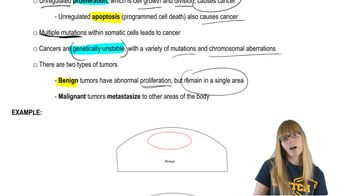
Cancer arises through multiple genetic and environmental changes over time. Besides inheriting a mutation like BRCA1, additional mutations or cellular changes must accumulate to trigger uncontrolled cell growth and tumor formation.
Video consigliato:
Percorso guidato
09:46
Cancer Characteristics

Role of Environmental and Lifestyle Factors

Environmental exposures, lifestyle choices, and hormonal factors can influence cancer risk by causing DNA damage or affecting gene expression. These factors interact with inherited mutations to increase the likelihood of cancer development.
Video consigliato:
Percorso guidato
08:52
F Factor and Hfr
Pratica correlata
Domanda del libro di testo

Go to the website http://www.cancer.gov and select 'Cancer Types' on the top menu bar. Scroll down to 'Breast Cancer' and click. Select 'Cases & Prevention' from the options. Click 'More information' and select 'BRCA Mutations: Cancer Risk and Genetic Testing'. Use the information on this page to answer the following questions. With regard to the results of genetic testing for BRCA1 and BRCA2 mutations, what is meant by a 'positive result'?

410
views
Domanda del libro di testo

Discuss the advantages (and possible disadvantages) of the different approaches to reverse genetics.

611
views
Domanda del libro di testo

The inheritance of certain mutations of BRCA1 can make it much more likely that a woman will develop breast or ovarian cancer in her lifetime. Can you say with certainty that a woman inheriting a mutation of BRCA1 will definitely develop breast or ovarian cancer in her lifetime? Why or why not?

452
views
Domanda del libro di testo

Do you think it is important that participation in community-based genetic screening be entirely voluntary? Why or why not?

481
views
Domanda del libro di testo

Describe how CRISPR–Cas has been modified to create a genome-editing tool.

724
views
Domanda del libro di testo

Go to the website http://www.cancer.gov and select 'Cancer Types' on the top menu bar. Scroll down to 'Breast Cancer' and click. Select 'Cases & Prevention' from the options. Click 'More information' and select 'BRCA Mutations: Cancer Risk and Genetic Testing'. Use the information on this page to answer the following questions. What features of family history increase the likelihood that a woman will have a harmful mutation of BRCA1 or BRCA2?

428
views