Ch. 15 - Recombinant DNA Technology and Its Applications
Sanders - Genetic Analysis: An Integrated Approach 3rd Edition
Sanders3rd EditionGenetic Analysis: An Integrated ApproachISBN: 9780135564172Non è quello che usi tu?Cambia libro di testo
Capitolo 15, Problema 9

Chimeric gene-fusion products can be used for medical or industrial purposes. One idea is to produce biological therapeutics for human medical use in animals from which the products can be easily harvested—in the milk of sheep or cattle, for example. Outline how you would produce human insulin in the milk of sheep.

Guida verificata passo dopo passo
1
Identify the human insulin gene sequence that needs to be expressed in sheep.
Design a suitable vector that includes the human insulin gene and regulatory elements necessary for expression in sheep mammary glands.
Introduce the vector into sheep cells, typically using a method like microinjection into fertilized sheep eggs.
Implant the genetically modified embryos into surrogate sheep mothers to develop into transgenic sheep.
Once the transgenic sheep mature, collect and analyze the milk to confirm the presence and proper folding of human insulin.

Risposta video verificata per un problema simile:

Questa soluzione video è stata consigliata dai nostri tutor come utile per risolvere questo problema.
Durata del video:
2m

Concetti chiave

Ecco i concetti essenziali che devi comprendere per rispondere correttamente alla domanda.

Gene Cloning

Gene cloning is a molecular biology technique used to create copies of a specific gene. This process involves isolating the gene of interest, such as the human insulin gene, and inserting it into a vector, typically a plasmid. The vector is then introduced into a host organism, allowing it to express the gene and produce the desired protein.
Video consigliato:
Percorso guidato
07:
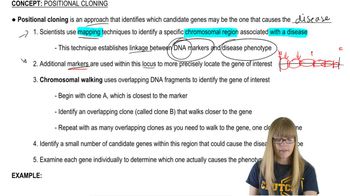
Positional Cloning

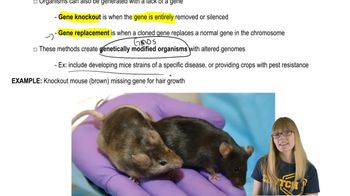
Transgenic Animals

Transgenic animals are genetically modified organisms that have had a foreign gene inserted into their genome. In the context of producing human insulin in sheep, the sheep would be engineered to carry the human insulin gene, enabling them to synthesize insulin in their milk. This approach leverages the natural lactation process to harvest the therapeutic protein efficiently.
Video consigliato:
Percorso guidato
09:12
Transgenic Organisms and Gene Therapy

Protein Harvesting and Purification

Protein harvesting and purification involve extracting and refining proteins from biological sources for therapeutic use. After the transgenic sheep produce milk containing human insulin, the insulin must be separated from the milk and purified to ensure it is safe and effective for human use. This process typically includes techniques such as centrifugation, filtration, and chromatography.
Video consigliato:
Pratica correlata
Domanda del libro di testo

Figure E.1 illustrates the results of an electrophoretic analysis of 13 CODIS STR markers on a DNA sample and identifies the alleles for each gene. Table E.2 lists the frequencies for alleles of three of the STRs shown in the figure. Use this information to calculate the frequency of the genotype for STR genes FGA, vWA, and D3S1358 given in Figure E.1.

599
views
Domanda del libro di testo

Additional STR allele frequency information can be added to improve the analysis in Problem 8. The frequency of D8S1179₁₂ = 0.12. The frequency of D16S539₁₈ = 0.08 and of D16S539₂₀ = 0.21. Lastly, D18S51₁₉ = 0.13 and D18S51₂₀ = 0.10. Combine the allele frequency information for these three STR genes with the information used in Problem 8 to calculate the frequency of the genotype for six of the STR genes.

506
views
Domanda del libro di testo

Using animal models of human diseases can lead to insights into the cellular and genetic bases of the diseases. Duchenne muscular dystrophy (DMD) is the consequence of an X-linked recessive allele.

How would you make a Drosophila model of DMD?

437
views
Domanda del libro di testo
Why are diseases of the blood simpler targets for treatment by gene therapy than are many other genetic diseases?
440
views
Domanda del libro di testo
Compare methods for constructing homologous recombinant transgenic mice and yeast.
481
views
Domanda del libro di testo

The frequencies of the four alleles contributed to the child by possible father F1 in Problem 7 are 0.18, 0.23, 0.13, and 0.14. Make a statement about the possible paternity of F1 based on this analysis.

458
views