Ch. 15 - Recombinant DNA Technology and Its Applications
Sanders - Genetic Analysis: An Integrated Approach 3rd Edition
Sanders3rd EditionGenetic Analysis: An Integrated ApproachISBN: 9780135564172Non è quello che usi tu?Cambia libro di testo
Capitolo 15, Problema 6

The human genome is 3×10⁹ bp. You wish to design a primer to amplify a specific gene in the genome. In general, what length of oligonucleotide would be sufficient to amplify a single unique sequence? To simplify your calculation, assume that all bases occur with an equal frequency.

Guida verificata passo dopo passo
1
Understand that the goal is to find the length of an oligonucleotide (primer) that will uniquely bind to one specific sequence in the human genome, which is 3 × 10⁹ base pairs (bp) long.
Assume that each base (A, T, C, G) occurs with equal frequency, so the probability of any specific base at a position is 1/4.
Calculate the total number of possible sequences of length n as 4^n, since each position can be one of four bases.
To ensure uniqueness, the number of possible sequences of length n should be at least equal to the size of the genome, so set up the inequality: 4^n  3 imes 10^9.
Solve for n by taking the logarithm base 4 of both sides: n  rac{\(\u\)221A \(\text{log}\)(3 imes 10^9)}{ \(\text{log}\)(4)}. This will give the minimum primer length needed to uniquely amplify a single sequence.

Risposta video verificata per un problema simile:

Questa soluzione video è stata consigliata dai nostri tutor come utile per risolvere questo problema.
Durata del video:
5m

Concetti chiave

Ecco i concetti essenziali che devi comprendere per rispondere correttamente alla domanda.

Primer Specificity and Length

Primer specificity depends on its length and sequence uniqueness. Longer primers are more likely to bind uniquely to a target sequence in a large genome, reducing non-specific binding. Typically, primers between 18-25 nucleotides provide a good balance of specificity and efficient binding.
Video consigliato:
Percorso guidato
07:39
Genetic Cloning

Probability of Sequence Occurrence

The probability of a specific oligonucleotide sequence occurring in a genome depends on its length and base composition. Assuming equal base frequency, the chance of any particular sequence of length n is (1/4)^n. This helps estimate how long a primer must be to appear uniquely in a genome of given size.
Video consigliato:

Human Genome Size and Complexity

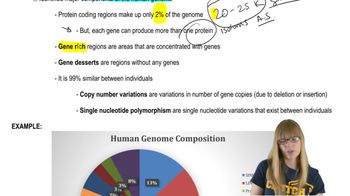
The human genome contains approximately 3×10⁹ base pairs, which influences primer design. To ensure a primer binds uniquely, its length must be sufficient so that the expected number of occurrences of that sequence in the genome is close to one or less, considering the genome's size and base distribution.
Video consigliato:
Percorso guidato
06:51
Human Genome Composition
Pratica correlata
Domanda del libro di testo

The results shown are from a DNA test for four genes used in a paternity identification case. DNA for the mother (M) and her child (C) are shown along with DNA from two possible fathers, F1 and F2. Based on the exclusion principle, is either man excluded as the possible father? Explain.

645
views
Domanda del libro di testo

Using the genomic libraries, you wish to clone the human gene encoding myostatin, which is expressed only in muscle cells.

How frequently will a clone representing myostatin be found in the cDNA library made from muscle?

517
views
Domanda del libro di testo

Using the genomic libraries, you wish to clone the human gene encoding myostatin, which is expressed only in muscle cells.

How frequently will a clone representing myostatin be found in the genomic library made from brain?

504
views
Domanda del libro di testo

A victim of murder is found to have scrapings containing skin cells under several of her fingernails. Genetic analysis confirms that the DNA isolated from these cells came from the same individual and does not match the DNA of the victim. The results shown below are for six CODIS STR markers from the crime scene DNA (from under the victim's fingernails and presumed to be the murderer's), and from three suspects (A, B, and C) who have been detained for questioning about the murder. Is there a failure to exclude any of the suspects? Explain.

505
views
Domanda del libro di testo

Using the genomic libraries, you wish to clone the human gene encoding myostatin, which is expressed only in muscle cells.

How frequently will a clone representing myostatin be found in the cDNA library made from brain?

578
views
Domanda del libro di testo

A victim of murder is found to have scrapings containing skin cells under several of her fingernails. Genetic analysis confirms that the DNA isolated from these cells came from the same individual and does not match the DNA of the victim. The results shown below are for six CODIS STR markers from the crime scene DNA (from under the victim's fingernails and presumed to be the murderer's), and from three suspects (A, B, and C) who have been detained for questioning about the murder. Do the STR results exclude any of the three suspects? Explain.

430
views